
Volodymyr Viatrovych, historian and civil activist, is one of the EuroMaidan’s leading faces. Since November 25, 2013 he has been working on the Maidan’s stage as an emcee representing the “EuroMaidan’s Civil Sector” together with Ruslana Lyzhychko.
Following the transformation of the EuroMaidan into the EuroRevolution, Viatovych has been called upon to coordinate massive protests, utilizing his experience as a revolutionary and community activist from the “For the Truth!” movement during the “Ukraine without Kuchma” protests and coordinator of the “Black Pora” movement of 2004. Armed with only a megaphone, Viatrovych led a column of demonstrators to blockade the Cabinet of Ministers of Ukraine, the Ministry of Internal Affairs (MIA) as well as the Ukrainian Parliament. With the same megaphone he also defended a barricade on Instytutska street from the Berkut attack on December 11, 2013.
“It was the most emotional night to date, because we were determined to stand our ground to the end but didn’t know whether or not we’d be alive when the sun rose. When it started, I gave orders through the megaphone but after it broke, all I could do was yell. I shouted different things, but what I remember shouting most was: “Every moment we stand together, is another moment of our victory! We must stand till the dawn!”
In his opinion, the main challenge facing the Maidan now is not the use of force to quash the movement but instead diminishing numbers and a constant rotation of reinforcements. “After the massive weekend protests, the number of activists decreases significantly during the week. A lot of them leave Kyiv and go home. Seasoned coordinators are forced to leave us at the most vulnerable time. And that means their jobs are performed by novices. Yet, when the veterans return, the circumstances have already changed and they have to adapt again,” Viatrovich demurred after another big Sunday rally. But he shows no signs of pessimism. He compares today’s protests to the the efforts of UPA (Ukrainian Insurgent Army): ”In 1940-1950 it was much worse for the underground, because reinforcements were not rotated due to furloughs, but because they died in battle. Thus, we can overcome!”
In the following interview, Viatrovych discusses pessimism on the Internet, Yanukovych’s disregard for the Maidan, the potential transformation of the protest, and the political ambitions of civil activists.
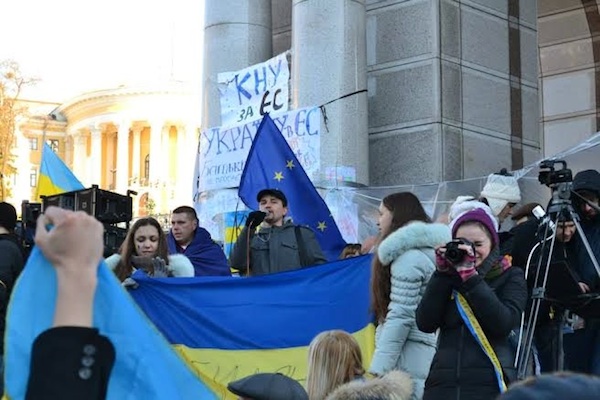
More than ten thousand people pass through the Maidan daily
– Does the “EuroMaidan’s Civil Sector” creation indicate the EuroMaidan is preparing to wind down and transition to a non-street format?
– I don’t think so. If we are talking about establishing a serious civil movement, then the Maidan, on the contrary, may help to create it.
Besides, one should understand that the Maidan is a self-organized community. So even if the politicians suddenly decide that everyone should go home nothing would change. The Maidan is making decisions on its own.
– At the same time, the EuroMaidan has already been called a “weekend revolution” since after the regular weekend assemblies of thousands, many fewer people remain the day after the rally. To what extent is this rotation of people a problem from an organizational point of view? And is it possible to accomplish the Maidan’s goals with such a chaotic state of affairs? Remember the number of protesters grew every day in 2004.
–The difference is that back in 2004 about 60-70% of the protesters were students who could leave their regular lives and spend an extended period of time at the protests. Today the protesters are young working professionals who can stay in Kyiv for only two to four days. And the majority can only make it on the weekend.
It’s a challenge to work with these constraints, especially for the coordinators. But I think we’ve become quite good at tackling this problem. It is extremely gratifying to see Kyivans among those signing up for night shifts. They consider this their duty even though they need to go to work in the morning. In effect, a kind of shift system is being established.
– In real numbers, how many people are here on the Maidan on weekdays?
– On weekdays the turnover is quite high. People come to stay for several hours or sign up for a shift. Generally, around ten thousand people pass through the Maidan daily. And at any given moment, for example during lunchtime, there are around three thousand people. This number increases as evening approaches, because people finish work and the program becomes more interesting.
– Would a nation wide strike such as the one proclaimed on the December 1, 2013 during the largest assembly change this? Even though people remained at work the following day.
– That’s best answered as a historian and not as an activist. A strike is a mechanism of influencing society and politicians during the industrial era. Industrial plant workers could paralyze an economy by going on strike. We’re living in a postindustrial era now and there are very few large factories, except in the East, where the spirit of the Maidan is weaker.
Accordingly, the only place where a strike may have some visible effect is a university, hence the popularity of student strikes. If several thousand students strike, academic activities come to a complete stop.
When the vast majority of people work in offices, other forms of striking are impossible. Even if people left their offices en masse, the economy would continue to function.
Hence all these calls to go on strike are a little antiquated. Not to the same degree as say seizing the telegraph as was done in 1917, but striking isn’t the same method of influence as it was in the 90s.
– Are the coordinators thinking of winding down the Maidan because of the fickleness of the people?
– There are different moods. It’s obvious that some people are tired, but the notion of winding down is not a dominant one. However, the idea of a Maidan transformation is being discussed. For example, there is an idea to narrow the Maidan’s activities to infrastructure maintenance and guarding the barricades on weekdays without engaging thousands of people and to host large assemblies on weekends. In other words, the idea is to create a fluctuating Maidan.
There is no discussion at all about a complete winding down of the Maidan, because it has not fulfilled all of its potential yet. The Maidan can still influence the situation in Ukraine as well as Ukraine’s foreign policy.
– In your opinion, how long will the Maidan last?
– The Maidan will decide its own fate. Gradually it will wind down, depending on the goals and challenges ahead. I can tell you for sure that the Maidan will last through the New Year. Generally, it is difficult to develop a strategy for the next few weeks. We have to be quite flexible and adapt to, as well as change, emerging situations.
Yanukovych wants to ignore the Maidan. But the Maidan is not going anywhere
– The Maidan has been described as having the power of influence. How does it use this influence? Because Yanukovych acts as though the Maidan is irrelevant and is seems to be ignoring it.
– The Maidan has become a territory in its own, free from government control and is a constant reminder for Yanukovych that he does not control the situation in the center of the capital. His political partners and foreign politicians see this everyday. The Maidan is a sign of his weakness, because even after using brutal force he has not changed anything and has accomplished nothing.
His stubbornness and insistence in ignoring the Maidan are not signs of his political will or persistence. He does not understand that circumstances in Ukraine and in the world are constantly changing. The fact that Yanukovych does not change himself is a guarantee that he will fall very quickly and find himself alone and in a very different set of circumstances.
– Do you think Yanukovych’s complete disregard of the Maidan is a deliberate strategy or simply because he doesn’t know how to deal with it?
– I’m not sure whether this is a deliberate strategy or infantilism, like when a toddler hides its head under its mother’s skirt in order not to see something that scares it. Yes, he does not want to deal with the Maidan. However, the Maidan is not going to go away. And the problems don’t solve themselves.
During his press conference when he answered questions about the Maidan it was obvious he was very nervous, his voice cracked, his prepackaged answers scattered away, and started to talk nonsense. The Maidan strongly affects him and shatters his composure despite attempts to keep a straight face.
– Don’t you think that by ignoring the Maidan’s demands Yanukovych is trying to accomplish his goal: destroy the Maidan by stimulating pessimism among protesters?
– In fact the people who are physically participating in the Maidan’s assemblies are much more optimistic, compared to those who stay at home and express their opinions on-line. I constantly monitor trends both on the Maidan and on the Internet and have noticed a big difference. There is more aggression on the web, a lot of people want to storm government administrative buildings although they are not ready to do this themselves.
Those people who have already been part of the Maidan and have directly participated in conflicts with authorities have a more sensible view of things and realize that the Maidan still has potential. Whereas people who come and stay on the Maidan for a couple of days, take photos, upload them to social networks, don’t meet with those they want to and can’t figure out how to help, become demoralized: “Everything is lost! The Maidan is going to fail! There is nothing to do there anymore!”
The panic on the web is also caused by a lot of people expecting a swift victory. And they want to be a part of it. Consequently, after it had become evident that there will be no swift victory, and this will take time, hard work, and perseverance, these people return to their normal lives and start to make excuses for why they are no longer involved: “It will not work out anyway,” or “The Maidan is dying and it is better to leave now rather than be a witness to its slow death.”
This is part of human nature: everybody wants to be a part of something that brings immediate satisfaction, but only the truly persistent are ready to fight until the final victory. I thank God there is no shortage of these persistent people.
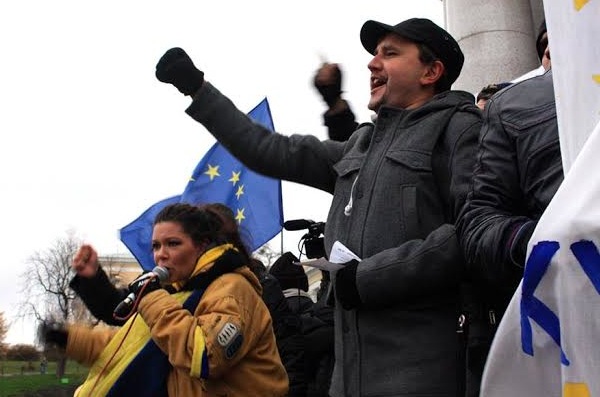
Ukrainians have excelled at applying European methods of resistance
– Do you think it is possible the protestors will use force? For instance a number of protesters might finally lose patience and mount an assault?
At the moment all assaults are taking place only on the web. The aggressive mood has almost completely dissipated after December 1, 2013. Those people who have taken responsibility for the process understand that we will be victorious only through non-violent protest.
Ukraine and its citizens have gained the admiration of the world over the last several weeks precisely because of the peaceful, non-violent resistance. Because even in European countries, confrontations often end up in property destruction and burglaries.
Ukrainians have shown a higher class of European resistance. And I also think that the dominant leaders among the Maidan’s coordinators are smart, and will not condone the use of violence as it would discredit the Maidan and give Yanukovych an excuse to use extreme force.
– Does a postponement of a court order to clear Khreshchatyk street until January 28 take off some heat? Is the threat of a Maidan dispersal by force still present?
– After the events of December 11, 2013, it’s difficult to expect rational actions from the government. To attack the Maidan on that day was political idiocy. Nonetheless, that idiocy came true. That’s why the Maidan has to be vigilant and prepare for any provocations or open attacks and threats from within.
For example, there were warnings about trouble happening between the two opposing Maidans. This didn’t happen, and a lot of people that initially came to take part in the “AntiMaidan” (a pro-government rally) got some of the Maidan’s spirit and joined the Maidan during Okean Elzy’s concert.
– Does this mean that the threat of a civil war, widely rumored, has dissipated?
– The events of December 1, 2013 happened not only because of the actions of provocateurs. There really was an aggressive mood in the crowd and a lot people genuinely believed that the seizure of the Presidential Administration building would solve the problem. However, after a week of coordination by civil activists, any calls for violence are now perceived as provocations. An atmosphere has been created which deters provocateurs from using their tricks to incite violence.
Although if the authorities want to unleash full warfare and resort to large scale provocations, anything is possible. Still, everyone will see this as a provocation.
– None of the protesters’ demands have been fulfilled by the authorities so far. Nevertheless, one often is told of the Maidan’s achievements by speakers from the stage. What are those achievements, from your perspective?
– The most significant achievement is the Maidan itself and the fact that people have been there. The Maidan is changing each individual- he starts to perceive himself as a citizen, a social creature who is able to self-sacrifice and help others.
The Maidan has also significantly improved the public image of Ukraine. As you know, since 2008 the world press has been saying that Ukraine is weary. Despite this image, Ukraine has managed to make headlines again and has shown the world a different face. And this new Ukraine is ready to fight for its dignity and the dignity of its citizens who deserve to be a part of Europe.
– Do you believe that it is possible to find a way out of this political crisis and address the Maidan’s demands during the round table?
– A round table can be an instrument to help overcome a political crisis. But it should be a public one. Those kinds of round tables were held during the collapse of communist regimes in central and eastern Europe. It was their openness that became the most distinctive feature of those round tables. People knew what had been discussed, who had participated. On the contrary, the round tables that have been held here in Ukraine are a pale imitation.
If the authorities genuinely wish to start a useful dialog with protesters then they should at least meet the requested format of the round table.
A lot of civil activists are ready to get involved in politics
– At the moment it seems that instead of having a round table discussion with authorities, there will be a round table meeting of politicians and civil activists to establish a new movement. What conditions can be set for politicians who want to participate? And were there analogous movements in Ukrainian history?
– If we are talking about both a political party and civil movement, then it should have both politicians and civil activists. However, this doesn’t mean that a majority of the members of this hypothetical movement should be politicians. Such a movement should not rely on existing political parties. Otherwise it will never become an independent political-civil movement similar to “Solidarity” in Poland or the Ukrainian “Rukh” movement of the late 1980’s.
We should not repeat the dismal experience of such movements as the “Dictatorship Resistance Committee” or “Stand up, Ukraine!” both of which were built on political party structures and did not bring anything new to the picture.
It is crucial for that the basis of this movement to be the Maidan’s principles of multiple leaders, self-organization and financial transparency.
It is also important that the goal remain “System Change” and not simply a change of politicians. And one of the tools to achieve this goal should be the unity of opposition parties in 2015-they should choose a single candidate for the Presidential elections.
– So you don’t expect early Presidential elections or Yanukovych’s resignation, do you?
– I think that it’s necessary to start explaining to people that there will be no quick outcomes and there is no reason to expect Yanukovych to resign at this time. People must be ready for a serious struggle that could last until 2015. They should also clearly understand that self-organization and self-defense are not a guarantee against political repressions.
After all Yanukovych will have enough time to deal with each civil activist, one by one. That is why we should use the Maidan’s momentum and become a united and organized power.
– At the beginning of EuroMaidan there was some tension between its political and civil parts or sectors. Are these tensions still present today when the Maidan’s momentum has slowed down and different ideas about its prospects are voiced? Do you think that opposition politicians want to wrap it up at the moment?
– I have not seen any disagreements yet. However, as a representative of the EuroMaidan’s Civil Sector, I would like to hear clear political goals from our opposition politicians. The only goal that I have heard and agreed with, is a resignation of the Government.
But opposition politicians should allocate more time to explaining to people how they are going to achieve this particular goal and what the Maidan’s input can be in this process. Instead we constantly hear populist rhetoric from them, for instance a call to fight on a boxing ring or a giving Yanukovych a twig from Saint Nicholas. Serious politicians should not use that kind of rhetoric, especially those who have been supporting the Maidan for a month already.
– Looking back at 2004, some critics said that the opposition politicians of those days did not have a clear plan what to do after taking the helm. Do they have one at the moment? Will this Maidan change the current political situation dramatically?
– This is one of the key points for me personally and for those people who work with me. We don’t want to stop after the removal of the current regime. We have already prepared several proposals that would prevent the emergence of another “Yanukovych” and halt the use of force by the “Berkut” against the population in the future.
It’s taken a lot of hard work, and we’ve named it the “Revolution Plan.” It’s still a work in progress and a group of lawyers are working on it. This is what we demand from any regime, regardless of the names of those in power. Because our highest goal is to change the system, not just the names.
If we see there is no progress under the current rules with the current politicians, then many of the civil activists are ready to change careers and enter politics in order to become the instruments of change themselves.
Source: Ukrayinska Pravda
Added 23.12.2013







