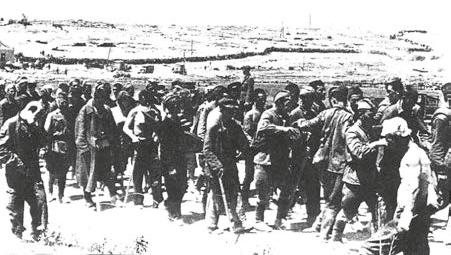
During the Crimean (Eastern) War of 1853–1856, the
city-fortress of Sevastopol was defended by troops of the
Russian empire for 349 days. The Anglo-French troops
eventually stormed and captured it. During the unsuccessful
defense, the Russians were forced to submerge their
entire fleet and it is no surprise that Russian publications
tell a different version of these events in order to morally
compensate and calm public opinion. A big role was given
to the cliché of a “city of Russian sailors”, which was later
transformed into the “city of Russian glory.”
The cliché was revived after the 250-day unsuccessful defense
of Sevastopol from the Wehrmacht in 1941–1942. It quickly became one of the “golden” Soviet myths about the
Second World War.
Indeed, the battle of the Sevastopol garrison was hard and
brutal. The city was attacked in November 1941, and required
all the strength of its defenders to withstand it.
However, the defense of Sevastopol had a rather humiliating
end. On 30 June 1942, the German troops took Malakoff
and the defense of the city became unpromising.
The High Command was evacuated over two days, 200
people by plane and 700 by submarines. The private staff
was demoralized. With no way to evacuate them, 100,000
Soviet soldiers who were defending Sevastopol were abandoned
to their fate. The soldiers continued the senseless
fight as they never received any orders to stop. As a result, up
to 20,000 soldiers were killed, while the rest were captured.
On 3 July 1942, the Soviet Information Bureau reported:
“Soviet troops left Sevastopol but the defense of the city will go
down in the history of the Great Patriotic War as one of the most
brilliant pages of its history. Sevastopol enriched the glorious combat traditions of the peoples of the USSR. Boundless courage
and rage to fight the enemy and dedication of the defenders
of Sevastopol, Soviet patriots inspired further heroic deeds in
the struggle against the hated occupiers.”