
Myth
20
The Communist Party – a Leadership of Strength, Creator of the Great Victory
Kyrylo Halushko
Leonid Brezhnev, Report dedicated to the 20th Anniversary of the Victory in the Great Patriotic War
“A force appeared in the world that crushed fascism. A decisive role in the defeat of humanity’s worst enemy was played by the Soviet nation, its glorious heroic army which was led by the Leninist Communist Party.”
■ The Essence of the Myth
All the achievements of the nation and army of the USSR during the war, are considered the result of the irresistible strength and advantages of the Communist regime. Citizens unanimously defended the Soviet system and demonstrated the monolithic unity of the Bolshevik Party.
■ Fast Facts
With the onset of the catastrophic German attack on a significant part of Ukrainian citizenry meant the eventual collapse of the Soviet regime within the newly occupied territory. The communist system had lasted only twenty years and demonstrated its cruelty, inhumane nature and at the same time, its economic failure. Half of the Ukrainian Communist Party who were left in the occupied territories renounced their ideology. The majority of people who remained were indifferent to the change of government, others joined the ranks of the resistance movement and there were those who even resorted to collaborating with the occupational regime.
■ Detailed Facts
Soviet society in the summer of 1941 was disoriented by propaganda, demoralized and divided by different attitudes towards the Soviet regime and the Germans.
The Communist’s foreign policy made a 180 degrees U-turn in 1939 when the “German fascists” became friends and not enemies in the Soviet press – which was a complete surprise for Soviet citizens. The USSR was Germany’s partner for nearly two years, despite the obvious “ideological” conflict. Anti-communism remained as an integral part of the Nazi ideology. Despite this, the imperial ambitions of the USSR allowed them to enter into an alliance with Hitler’s regime and proclaimed them “friendly”. It was a surprise and shock for the people being attacked by the Reich.
The other part of Soviet society hid their opposition to the Communist regime by their conformist behavior. During the Holodomor of 1932–1933 and the Great Terror of 1937–1938, the Soviets revealed their criminal nature and economic inefficiency in Ukraine. During the annexation of Galicia and Volhynia in September 1939, Sovietization also led to a dissatisfaction with the new government from the general population and the strengthening of the anticommunist liberation movement.
On the other hand, in the summer of 1941, a certain part of society supported the Communist authorities such as a significant part of the Komsomol youth who were educated by Soviet propaganda. However, the older generation who had experienced the frustration of twenty years of “people’s power” and the peasants, who were more radical than the city residents were not supportive: “it did not give us anything good and we should not defend it.”
The huge army, in spite of the prewar propaganda, proved to be unable to protect the people. By the end of 1941, the Wehrmacht lost 300,000 men. At the same time, the Red Army lost four times that, about 1.2 million. A further 3.9 million Soviet soldiers and officers were held in captivity. Large areas were quickly occupied. The catastrophic defeat of the Red Army in the summer of 1941 resulted in the near collapse of the Soviet regime in some Ukrainian areas.
The NKVD informed the top leadership about this oppositional sentiment. One of these situational reports was dated 25 June from Kyiv, only three days after the start of German aggression:
“Kozhemiankin, a laboratory assistant in the Kyiv Research Institute of Labor and Occupational Diseases: ‘…Let the devil take them, so that someone else comes in quicker. Let Hitler come, it can’t be worse.’”
Party officials and civil servants were the first to leave the territories that were threatened by German occupation. Against this background, the Ukrainian Communist Party was in a state of half-life. At the time of the German attack, the Ukrainian republic’s party consisted of about 565,000 people. One-fifth of the Ukrainian communists illegally left the republic’s territory as refugees. Two-thirds were officially evacuated. Only 150 thousand members of the Communist Party remained in the occupied territories. And only 40 thousand of those carried out underground work and participated in guerrilla warfare.
Some communists took part in the resistance movement and others supported the occupational authorities. Of those who remained in the occupied territory, 46,500 thousand were killed by the German punitive organs. Twenty-two communists registered with the Gestapo, 34,000 destroyed their party membership cards and 6,000 renounced their party affiliation.
Red Army soldiers are captured in the Kyiv region (September 1941)
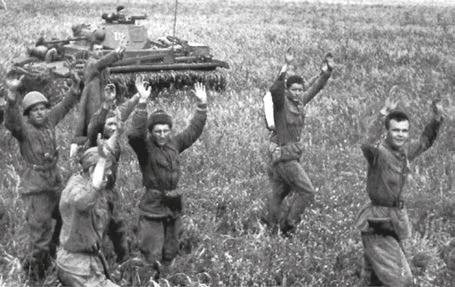
After this, when the Germans were expelled from Ukraine, from the 113,890 members of the Ukrainian communist party who survived the occupation, more than half failed to renew their membership in the party.
Demoralization also swept through the Red Army in the summer of 1941. Mobilization was under threat. The army ranks at that time were filled up to 200,000 volunteers, while 2 to 3 million recruits remained in the occupied territories after deserting, due to changes to the front lines and for “other reasons.” During the second half of 1941, the NKVD detained 685,000 people on suspicion of desertion. Officially, the number of deserters from the Red Army during the war was estimated at between 1 and 1.2 million people. Most were surrounded in the “cauldron” in the summer of 1941 and many became prisoners.
Commissar Beria said that in 1941, about 10,000 deserters were hung or shot. We cannot rule out that these figures were underestimated.
That was why on 16 July 1941, the institution of political officers was restored. They were to follow the commanders of military units.
Red Army soldiers surrendering
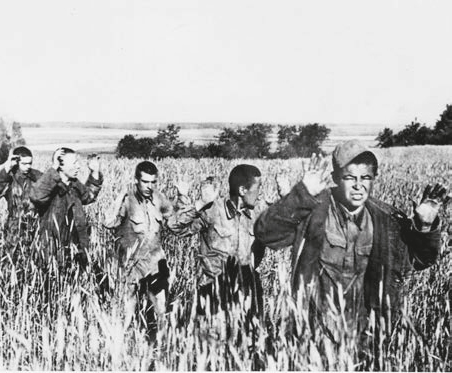
Another indicator of the Soviet leadership’s distrust of the military was in decree No. 001919, which, in September 1941, introduced defensive squads for every division that would kill any retreating Red Army soldiers.
Soviet soldiers were kept on the front by many ways, not only through heroism but also through ruthless repression. On 28 July 1942, Stalin gave order No. 227 – “Not one step back” – that treated any retreat as treason and provided military tribunal sentences or executions in place of defensive squads:
“…Form within the limits of each army 3 to 5 well-armed defensive squads (up to 200 persons in each), and put them directly behind unstable divisions and require them in case of panic and scattered withdrawals of elements of the divisions to shoot in place panic-mongers and cowards and thus help the honest soldiers of the division execute their duty to the Motherland.”
That is why the “unshakable unity” of the party, army and the people are only propaganda clichés. Sometimes, the leadership role of the Communist party also meant aiming guns in order to enforce laws.
Later, from 1942 to 1943, people were motivated to change due to various reasons, including a new occupational regime of terror and the success of the Soviet troops in the East. But even between 1943 and 1944 the attitude of the Ukrainians in central Ukraine differed from attitudes in Galicia and Volhynia, and in Bukovyna and Bessarabia in their want for the return of the communists – their attitudes were different from other regions. After all, very often at this stage of the war, victory took place not thanks to but contrary to the role played by the Communist Party.







