
Myth
25
Bandera and the Ukrainian Nationalists Were Agents of the Nazi Secret Service
Igor Bigun
Anatoli Chaikovskyi, Bandera and Shukhevych were Agents of Hitler’s Secret Service and That’s It, Bulvar Gordona, 12 January 2010.
“…The Nuremburg Tribunal declared the SS, SD and other Nazi security services and organizations as criminals, and the OUN members took part in this. Subsequently, the UN General Assembly adopted the appendix: ‘All war criminals of the Second World War are subject to investigation, arrest and trial. They are not covered by a statute of limitations. They do not have the right of asylum…’ It’s a shame, that nobody had the idea to add an item on the prohibition of awarding the title of Hero to these people. Bandera and Shukhevych were agents of Hitler’s secret services, and that says it all.”
■ The Essence of the Myth
Stepan Bandera, Roman Shukhevych and all the other members of the OUN(B) were agents of the Gestapo, SS, SD or the Abwehr and performed only the tasks of these services. The UPA were also agents of the Third Reich intelligence and fought on the side of the Nazis.
■ Fast Facts
The cooperation between the Ukrainian nationalists and the German intelligence is an important fact. The myth however incorrectly evaluates the nature of the cooperation. The nationalists acted in the interests of the Ukrainian state, building a cooperation with the Abwehr as a situational alliance. The peak of this collaboration occurred in the period of 1939–1941, that is during the time that Stalin made a pact with Hitler. After the proclamation of the Act of the Ukrainian State in Lviv on 30 June 1941 and the subsequent arrest of the nationalist leadership, the Ukrainian nationalists and the Germans split permanently.
■ Detailed Facts
The origins of the myth lay in the wrong understanding of the period of cooperation between the OUN and Nazi Germany in the 1930s and early 1940s.
The OUN began to cooperate with Germany due to geopolitical considerations. Germany was a traditional enemy of Poland.
Also, the Ukrainian Military Organization (UVO) had contacts with the intelligence department of the democratic Weimar Republic in the 1920s. With the advent of Nazi power, Germany became the largest country on the European continent (except for the USSR), which actively sought to rebuild the Versailles system. This coincided with the interests of the OUN, as the victors of the First World War did not place an independent Ukraine on the map. Germany was seen as a situational ally for the Ukrainian nationalists.
It should be noted that OUN relations with Germany were not very rosy. After signing the Polish-German non-aggression treaty in 1934, the OUN leader Yevhen Konovalets, moved from Berlin to Switzerland. In the same year, Germany gave Poland the OUN leader Mykola Lebed, who was hiding there after the OUN’s attempt on the Polish Interior Minister Bronislaw Pieracki. Eventually, contrary to nationalist expectations, Hitler agreed to the Hungarian occupation of Transcarpathia and the Soviet occupation of western Ukraine. Moreover, the Ukrainian underground sharply criticized the Germans in their publications such as the Nation Building magazine. OUN and Lithuanian relations were much better, since they were mutual enemies of Poland.
However, Germany was the only real force able to challenge Poland and the USSR, and after the OUN split between Bandera and Melnyk, they continued collaborating with the Germans.
The OUN(B), through contacts with the Abwehr and individual general-sympathizers of the Ukrainian liberation movement, established military training for the organization’s members. In exchange for intelligence, the Germans allowed the nationalists to conduct training of paramilitary guards in factories (Werkschutz), in worker commands and police schools in the German occupied zone in Poland. In addition to this, the organization created a network of military courses independent from the Germans for all its members, including Stepan Bandera.
In February 1941, Bandera reached a verbal agreement with the head of the Abwehr, Admiral Canaris, and the commander of the Wehrmacht, von Brauchitsch, as to the creation of a Ukrainian Legion. With the help of the OUN, two battalions were formed: Nachtigall and Roland. They were to carry out reconnaissance and sabotage tasks. And after the beginning of the war, the function of Nachtigall was limited to guarding communication lines and Roland did not participate in any hostilities.
Stepan Bandera – Revolutionary OUN Leader
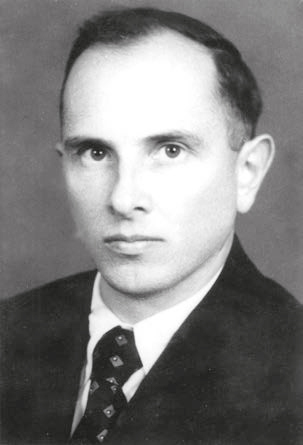
Additionally, the commander of Nachtigall was Ukrainian Roman Shukhevych. However, during the formation of the battalion, his soldiers refused to take an oath to Germany and swore allegiance only to Ukraine (for details, see Myth 24).
In August 1941, the Nazis reformed Nachtigall and Roland after the beginning of their repressive actions against the nationalists because they proclaimed the Act of the Ukrainian State. The Germans created the 201st Police Battalion out of some of the battalion’s personnel, which during March-December 1942 engaged in the protection of German strongholds and opposing the Soviet partisans in Belarus. Unlike Nachtigall and Roland, the creation of the 201st Battalion was not coordinated by the OUN(B), and Ukrainian soldiers went to serve there in order to avoid arrest by the Germans.
During the time when Soviet propaganda called the Nationalists agents of fascism, subordinates of Dr. Goebbels accused the OUN of working with the Bolsheviks. The German leaflet states that “Moscow gives the OUN orders” and “The OUN and the Bolsheviks are the same, and they must be destroyed!”
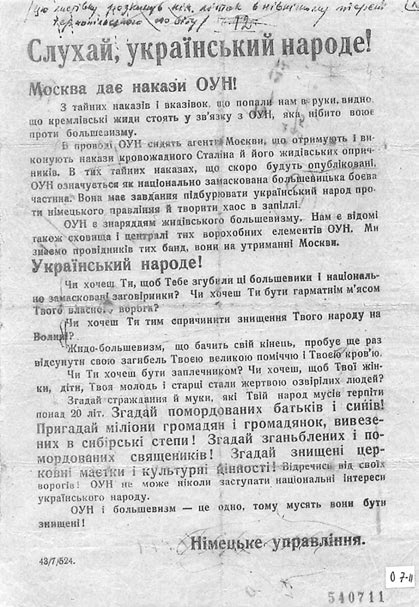
On 1 December 1942, the soldiers in the battalions refused to continue their service. Consequently, the Germans, dissolved this contract and the officers were arrested.
The mood and intentions of the battalions were eloquently conveyed in a verse from their song:
“The Forty-Second Year Passes,
Our Squad is Dissolving,
One to his Wife, Another to his Mother.
– And us, the rest, to the Insurgents!”
Shukhevych managed to escape custody and became the military referent of the OUN(B) Leadership and later led the organization.
There is no sense in exaggerating the importance of the Abwehr cooperation for the OUN(B). Typically, the Abwehr recruited OUN members in individual procedures but the OUN Leadership used this and gave these agents their own tasks. These relations had a pragmatic character for the union when both sides extracted their own benefits, without any political commitment. The Gestapo Chief Heinrich Muller told his colleague in the SD (Security Services) Walter Schellenberg, that the “Ukrainian nationalist leaders uncontrollably work on their own goals.”
Julian Kovalskyi – “Nachtigall” veteran and first Chief of Staff of the UPA. Killed in battle with the Nazis
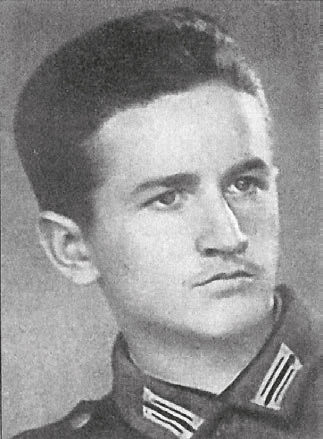
Notably, during the same period of 1939–1941, the ally of the Third Reich was officially the Soviet Union. Did this mean that Stalin became an agent of Hitler? In this game of war, everyone was trying to use each other for their own interests.
It is worth mentioning that part of the future leadership of the OUN and UPA served in the Red Army in 1940–1941. For example, the propaganda referent of the OUN(B) Leadership and the Chief of the Politico-Educational Department of the UPA General Staff in 1945–1951 was Petro Fedun, who was an artillery commander who fought on the Soviet-German front. However, these facts did not make the OUN(B) leaders into “communist agents.”
Today’s myth creators say that this picture features Bandera sitting in the center in a German uniform. In actuality, this is Reinhard Gehlen, a Wehrmacht officer
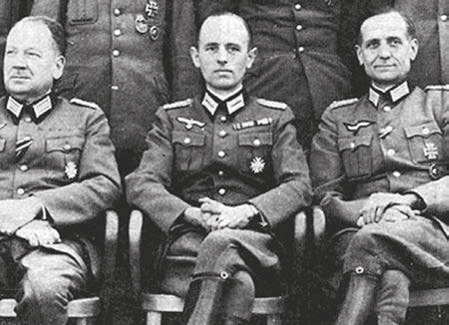
Immediately after the German attack on the USSR on 23 June 1941, the OUN(B) sent a memorandum to the Reich Chancellery as to how to solve the Ukrainian question after the collapse of the USSR. In it, among other things, were these words: “Even if German troops, upon entering Ukraine, are at first welcomed as liberators, that situation will soon change if Germany does not come to Ukraine to restore the Ukrainian state with its respective slogans.” Therefore, even at that point, the OUN(B) anticipated the possibility of an anti-German armed resistance movement if the Germans took a hostile position towards an independent Ukraine.
However, despite cooperation with Germany in the military sphere, the OUN(B) conducted its own political line. A vivid demonstration of this behavior was the declaration of the Act of the Ukrainian State on 30 June 1941 in Lviv. This was a complete surprise for the Germans – an independent Ukraine was not part of the Third Reich’s plans. On 5 July 1941, the Nazis arrested Bandera and on 9 July, the head of the newly created government, Yaroslav Stetsko.
From July-August, the occupiers pressured the leaders of the OUN(B) to withdraw the 30 June Act. However, they resolutely refused and were sent to Berlin prisons. From 15 September 1941 to the end of the war, German punitive authorities arrested close to 1,500 OUN(B) members. On 25 November 1941, the Security Police issued arrest and execution warrants for activists of the “Bandera group” who were “preparing an uprising in the Reichskommissariat Ukraine in order to create an independent Ukraine.”
The military training obtained with the help of the Germans was later useful during the anti-German struggle of the OUN and UPA in 1942–1944. Many veterans from the Nachtigall and Roland battalions and the 201st Police Battalion joined the UPA as instructors or military commanders. From the first UPA headquarters, the General Commander Vasyl Ivakhiv (otherwise known as “Som”) the Chief of Staff Julian Kovalskyi (“Harpun”) and the Adjunct of the General Staff Semen Sniatetskyi (“Sivka,” “Siyka”), all fell in battle with the Germans on 13 May 1943. The last two were former officers of the “Nachtigall” Battalion.
It is doubtful that agent-puppets of the intelligence services would use such independent actions. After all, how can a puppet fight against its leader and sponsor?
The idea that the OUN(B) leadership were German agents or that they were blindly executing German intelligence orders cannot be considered. The OUN’s struggle had its own logic – to achieve an independent Ukrainian state. All their efforts, including military cooperation with the Germans, were subject to exactly this one purpose. The OUN hid their plans from the Nazis. And the Declaration of Ukrainian State Act on 30 June 1941 became a moment of truth in OUN relations with the Germans.
It became apparent that in fact, the German Nazis and Ukrainian nationalists were enemies.







