
Myth
33
The UPA Fought for a Mono-Ethnic State
Volodymyr Viatrovych
Aleksandr Diukov. Attempts to Rehabilitate the OUNUPA – A Crime Against Victory, 13 October 2008.
“Naturally, different nationalities held different policies but in the end, Ukraine was to become a Ukrainian-nationalist mono-ethnic state and this could only be achieved through the shedding of a large amount of blood, a very strong repression against the representatives of national minorities.”
■ The Essence of the Myth
The soldiers of the Ukrainian Insurgent Army organized the mass annihilation of the non-Ukrainian population, wanting to realize their own political program, which included the creation of a mono-ethnic state devoid of minorities.
■ Fast Facts
The aim of the Ukrainian insurgents was an independent Ukrainian state. This is what was stated in their program documents. There is no evidence that its citizens could only be ethnic Ukrainians. The Ukrainian underground produced informational materials which were aimed at representatives of different ethnic groups with the aim to involve them in a joint anti-Nazi or anti-Soviet struggle. Moreover, there were other nationalities apart from Ukrainians in the ranks of the UPA.
■ Detailed Facts
The Ukrainian Insurgent Army was created in late 1942. Its main organizers became the leaders of the Organization of Ukrainian Nationalists, but namely its Bandera wing, thus the program provisions of the OUN(B) were formed on the basis of the UPA political strategy.
The Revolutionary OUN leadership, headed by Stepan Bandera, was created in February 1940. In December, the Organization published its first public statement, a manifesto to Ukrainians and other nations of the USSR about the joint struggle for the creation of national states. The main purpose was the struggle against the Soviet occupational regime: “We, Ukrainians, will fly the flag of our struggle for the freedom of nations and people.”
This struggle was to bring freedom to all people enslaved by Moscow and to create their own lives on their own native lands based on their own decisions. Its objectives also included dignity and human freedom, freedom of conscience, religion and belief.
The manifesto contained no calls or demands for the elimination of any minority. Instead, it ended with a call for a joint struggle of all the oppressed peoples for the collapse of the Soviet empire. The key slogan of the Ukrainian insurgents for the next decade was “Freedom to nations! Freedom of the people!” which was written for the first time in the December 1940 manifesto.
In April 1941, the Second Great Assembly of the Bandera wing of the OUN took place in Krakow. A resolution of this Assembly became the strategy of the struggle for Ukrainian independence during the war.
As in the December manifesto, several provisions emphasized the need to fight for an independent Ukrainian state, for the “freedom of all peoples oppressed by Moscow, and for their right to have their own state.”
The Poles and Jews are the only minorities specifically mentioned in their orders. It was noted, that the OUN will fight only those Polish groups whose aimed to restore the Polish occupation of Ukrainian lands.
As for Jews, rumors of their mass support for the Communist regime had been popular since the interwar years. But, besides that, the Jewish pogroms were viewed by the nationalists as an attempt to divert attention from their main goal – obtaining Ukrainian statehood from their main enemy, Moscow. Therefore, fighting against the Jews was conducted only to the extent that they were considered the mainstay of the Communist regime. No calls for the destruction of all Poles, Jews or other national minorities were ever made in OUN resolutions.
Certain provisions from the Second Great Assembly were expanded and concretized in May 1941. This mainly concerned the instructions which were to be realized after the promotion of Ukrainian nationalist authorities once the Soviet troops had retreated under pressure from the German army.
These guidelines did not contain instructions about the destruction of all national minorities. It proclaimed the slogan of “Ukraine for Ukrainians” but this meant that power in Ukraine should belong to the Ukrainians, and not the occupiers which they would fight until they stopped occupying Ukrainian lands.
Fragment of the appeal of the Supreme UPA Command to the Russians ending with: “Long Live the Independent Russian Nation State!” Long Live an Independent Ukraine! Long Live the Independent States of People in Europe and Asia!” (June 1943)
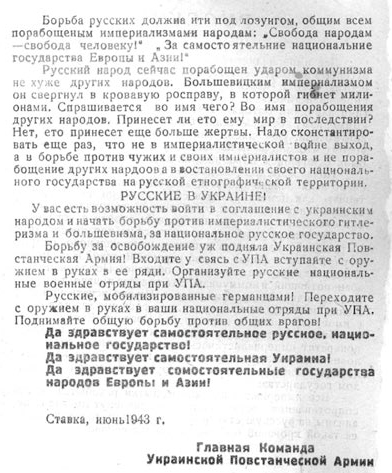
The May 1941 provisions also discussed the possible elimination of Polish, Russian or Jewish leaders. Representatives of ethnic groups were considered suspicious because they were believed to support the former occupational regimes, either the Polish or Soviet.
But suggestions of a possible liquidation consisted not of entire ethnic groups but rather specific activists who collaborated with the enemy or fought against the OUN and the Ukrainian state.
Other representatives of national minorities were guaranteed the same rights as ethnic Ukrainians.
Similar ideas concerning ethnic groups were formulated in the decisions of the second OUN conference in 1942. It also signaled out Poles and Jews. As for the first group, it emphasized the need for “reducing Polish-Ukrainian relations” and in relation to the Jews, they talked about the unsuitability of taking part in anti-Jewish actions because it took attention away from their main enemy. For all national minorities friendly relations were proposed and a cooperation on the basis of a common front of oppressed peoples.
UPA Command appeal to the people of Central Asia: “The Front is Falling Apart, Now is the Time for a National Revolution! The Enslaved Peoples of Eastern Europe and Asia! Join the UPA!” (June 1943)
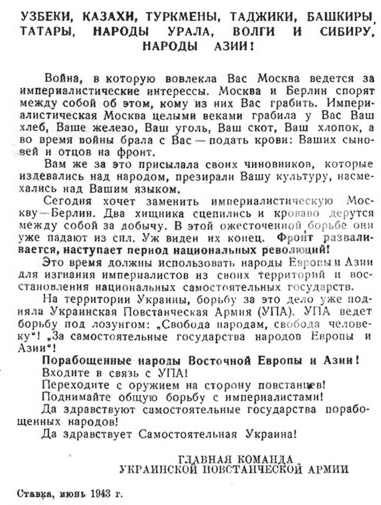
In February 1943, the third OUN conference once again repeated the idea of creating a common front of oppressed people for a joint struggle against state-occupiers.
The resolutions of the Third Extraordinary Great OUN Assembly in August, 1943 finally approved the resolution on “the full right of national minorities to cultivate their own form and content of their national culture” and “equality of all citizens of Ukraine in public and civil rights and obligations, regardless of their nationality.”
There were no exceptions for “suspicious” ethnic groups in these texts. These decisions were the basis of the political program of the UPA, which was reflected in their document What the Ukrainian Insurgent Army Fights For.
The UPA consisted mainly of Ukrainians and was formed on territory covered by the insurgent struggle but other national representatives were also in their ranks.
Mandyk Haussman (1929–2013) – Jewish UPA insurgent
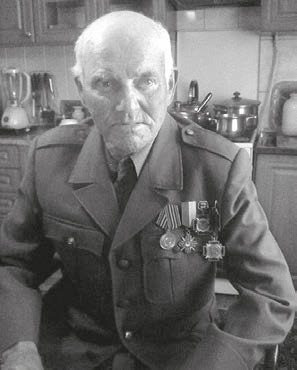
For example, Leiba-Itsyk Dobrovskyj, who was Jewish, worked in the political department at the UPA headquarters in Volhynia. He became the author of UPA leaflets to the people of the Caucasus and Central Asia which called on them to join the UPA. In the documents and memoirs there are other Jewish names who served as doctors in the UPA. This included Shaia Varm, who from 1943–1944 saved the lives of many insurgents, Samuel Noiman, Aron Kozlovskyj, Abraham Shtertser and others. For some time, Mandyk Khasman, a Jewish youth took part in one of the insurgent groups.
In the UPA from 1943–1944 so-called national units existed, including Uzbek, Georgian, Azerbaijani and others. Reports from Soviet partisans say that a part of the UPA at the beginning of 1944 was not Ukrainian by nationality. The documents also include numerous cases of the Ukrainian underground cooperating with the Jews, Poles, Czechs and representatives of other national minorities.
Therefore, the main goal of the UPA struggle was to obtain an independent Ukrainian state within the ethnic Ukrainian lands. Insurgents formulated their policy towards minorities depending on the attitude of the certain people or structures (and not nationalities as communities) to fight the UPA and the Ukrainian state.







