
Myth
41
Ukrainians – Butchers of the Warsaw Uprising
Maksym Maiorov
Marian Kaluski,
The Participation
of Ukrainians in
the Suppression
of the Warsaw
Uprising, kresy.pl,
29 January 2011
“Thus, the literature which relates to the Warsaw Uprising, is full of testimonies, information and documents which implements Ukrainians in this crime, who fought together with the Germans. Because of the extremely refined barbarism and manslaughter… In actuality, perhaps there is no publication on the Warsaw Uprising that does not question the Ukrainian barbarism during the uprising.”
■ The Essence of the Myth
The German Army units composed of Ukrainians, including the SS, played a significant role in the suppression of the Warsaw Uprising. The Ukrainian participation in the fight against the rebels was accompanied with war crimes.
■ Fast Facts
In fact, no Ukrainian formation had any important role in suppressing the uprising, but rather it was units of Russian nationalists and Cossacks. Russian collaborators were participants in the uprising and biased researchers later tended to call them “Ukrainians”. There was only one Ukrainian part of a battalion that was involved. There is no documentary evidence about them committing any massacres in Warsaw.
■ Detailed Facts
The Warsaw Uprising against the German occupation lasted from 1 August to 2 October 1944.
A speech by the Polish government in exile in London initiated the uprising. The main rebel fighting force was the Polish Home Army (AK). The aim of the uprising was to liberate the capital before the arrival of the Red Army.
But the rebels did not calculate the force that would be used against them. In early September, it became clear that German punitive units would be able to suppress it.
By that time, the Soviet troops were closing in on Warsaw. The zone of the uprising and the Soviet 1st Ukrainian Front was only divided by the Vistula River. Despite requests for assistance, Stalin’s support for the Warsaw Uprising was minimal. The Red Army moved into a general offensive.
The rebels who survived were forced to surrender to the Germans.
German troops in some areas of Warsaw resorted to tactics of total destruction of the rebels along with civilian and urban developments. War crimes were committed by SS formations, such as the SS Dirlewanger. Units were also composed of Soviet citizens in the German service.
In post-war Polish publications, it was widely believed that a large number of Ukrainians were among the German punitive troops. The Ukrainians were accused of war crimes against the residents of Warsaw. They even alleged that part of the SS Galicia Division took part in suppressing the uprising. Actually, the role of Ukrainians in the fight against the rebels was greatly exaggerated.
Rumors of the arrival in Warsaw of Ukrainian SS units spread even before the uprising. The Polish underground claimed that Ukrainian units committed terrible crimes against the civilian population. The prejudice of the Warsaw residents against the Ukrainians was due to the news about the bloody conflict between the Ukrainians and Poles in western Ukraine. And the Germans formed the 14th Waffen Division of the Armed SS out of the Galician Ukrainians. Therefore, during the uprising, Warsaw residents through this “learned” about the Ukrainians.
In the memoirs of Warsaw residents, collaborationist units from the USSR were usually referred to as “Ukrainian” or “Kalmyk”. The “identification” criteria was not affiliated with any national formations but rather the European or Asian appearance of its soldiers.
In fact, the vast majority of those so-called “Ukrainians” were soldiers from the regiment of the Russian 29th SS Division RONA and several battalions of Russian Cossacks. Some of them really were ethnic Ukrainians but associated themselves with Russia, not Ukraine.
Warsaw residents usually associated “Russians” with the Red Army. The Poles tried not to call the representatives of collaborationist formations “Russian”. Meanwhile, the same SS RONA formation, together with the SS Dirlewanger regiment were the ones who committed most of the war crimes in Warsaw. They fought almost from the very beginning to the very end of the uprising.
What was the role of the Ukrainian national forces who were in the service of the Germans in suppressing the uprising? The only example of this were the two companies of the Ukrainian Legion of Self-Defence (ULS) under the command of Petro Dyachenko. Another name of this unit was the 31st SD Battalion.
Officers of the consolidated RONA regiment during the Warsaw Uprising (August 1944). Among their fighters were one of the greatest war criminals in Warsaw
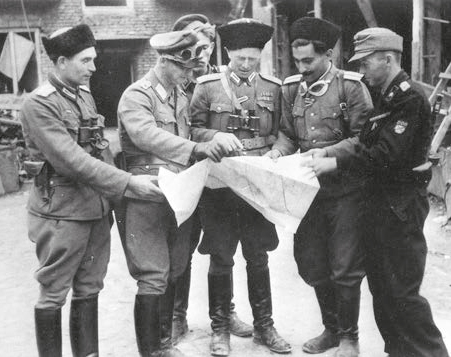
Together with other German units, the ULS destroyed the Soviet troops’ springboard on the left bank of the Vistula River and fought the AK in the coastal areas of Warsaw (Czerniakow and Powisle). Here, ULS soldiers fought until 23 September 1944.
An analysis of the Warsaw residents’ testimony about this period and place does not provide any grounds to assert that the ULS committed any war crimes. In any case, no “Ukrainians” are mentioned in connection with killing civilians.
The common myth that the SS Galicia Division was involved in the suppression of the Warsaw Uprising began to be used in Polish historiography. In fact, at the time of the uprising, the division did not exist. A few days before the explosion of the Warsaw Uprising, on 22 July 1944, it was crushed by Soviet troops during the Battle of Brody, which took place in western Ukraine. Most of the soldiers were killed, captured or transferred to the UPA. The remnants retreated to the Carpathian Mountains. The order to form a new Galician Division was only issued on 5 September. The first combat-ready units were created on 28 September in order to participate in the fight against the Slovak uprising.
Soldiers of the Ukrainian Self- Defence Legion
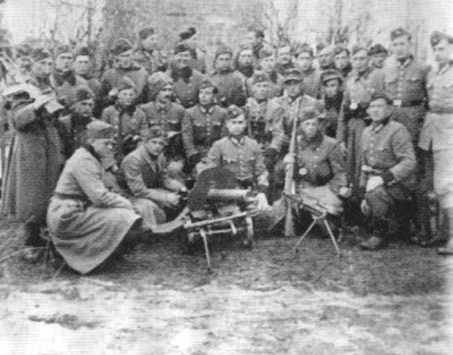
Thus, none of the SS Galicia Division units took part, nor could they take part, in the suppression of the Warsaw Uprising. However, at the time of Germany’s surrender a part of the Galician Division could have been soldiers who had fought against the Warsaw rebels. That is because on 6 March 1945, ULS soldiers combined with the Galicia division. But these sad facts do not change this fact: the large participation of Ukrainians in the suppression of the Warsaw Uprising is a myth.







