Myth
42
The Nuremburg Trials Condemned the Ukrainian Nationalists
Sergii Gromenko
Oleksandr
Volevodz, Prof.,
Moscow State
Institute of International
Relations,
6 March 2014
“There is documented proof that only on the territory of Ukraine 5.3 million people were killed due to the crimes of the Nazis and their henchmen. The ‘soldiers’ of the OUN-UPA, as well as their Nazi collaborators, participated in this… That is why, based on the principles of the Nuremburg Trials, Bandera and the Banderites were globally recognized as war criminals. That is why many of them were sentenced by the courts after the war and Bandera – killed.”
■ The Essence of the Myth
Bandera, personally, the OUN and UPA as a whole, were condemned at the Nuremberg Trial and even though they were not condemned, they are still considered war criminals.
■ Fast Facts
Neither Stepan Bandera or Roman Shukhevych, personally, or the OUN and UPA as an organization were convicted by the International Military Tribunal in Nuremberg. None of the 42 volumes of the Tribunal’s materials contain any convictions against them.
■ Detailed Facts
In the materials of the Nuremberg Trials, a comprehensive list of individuals and organizations are available that they consider criminal. The Ukrainian nationalists are not on that list. Out of the 42 volumes from the case, only 7 were published in the USSR in Russian which opened the space up for large-scale falsifications and distortions. Critics of Ukrainian nationalism hoped to find a sentence about Bandera in one of the unpublished volumes. However, analysis of the materials shows that there is no mention of Bandera and therefore, nothing can be construed about him.
In the 25th Volume, it states that the majority of Ukrainians in the worker camps aligned themselves to the “Bandera camp” and that immigrants follow both the anti-German “movements of Bandera and Melnyk.”
Volume 27 contains testimony about some mass revenge shootings of the “Bandera groups.”
In Volume 29, the “Bandera movement” is referred to along with their aims to achieve statehood.
In the 38th Volume, the commitment of the Ukrainians and the “Bandera movement” to the idea of independence is referred to.
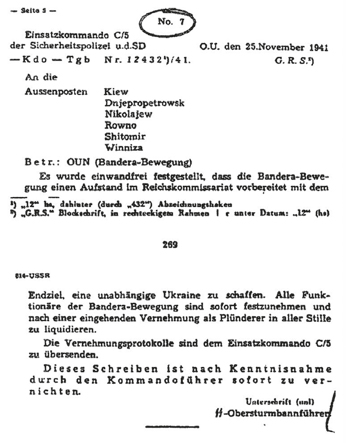
In Volume 39, an order from the Einsatzgruppen is revealed which orders the destruction of the OUN(B) as fighters for Ukrainian independence. Here is the short document in full:
“Einsatzkommand C/5
Auxiliary Police and SD
25 November 1941
Kyiv
Dnipropetrovsk
Mykolaiv
Rivne
Zhytomyr
Vinnytsia
Referring: OUN (Bandera movement)
It has been reliably established that on the territory of the Reichskommissariat, the Bandera movement is preparing a revolt with the ultimate goal of establishing an independent Ukraine. All members of the Bandera movement should be detained immediately and after a detailed examination under the guise of looters, to be privately eliminated. Minutes of the interrogations should be given to Operational Unit C/5. This document is to be destroyed by unit commanders after reading.
Obersturmbannfuhrer SS
Signature (unreadable)”
Russian researchers refer to materials like the interrogation of Abwehr Colonel Erwin Stolze, who mentioned the order of the “Ukrainian nationalist leader” Melnyk, codenamed “Consul 1”, and Bandera to immediately convene and provoke demonstrations in Ukraine during the German attack on the Soviet Union or to break the direct rear of the Soviet army and convince international public opinion in order to seemingly “collapse of the Soviet rear.”
However, firstly, this reference was only left in the speech of the Soviet prosecutor Nikolai Zoriya (Volume 7) and was never used in sentencing and secondly, the Abwehr during Nuremberg was not recognized as a criminal organization and thus cooperating with them in terms of the trial was not compromising.
And yet, during NKVD interrogations, even the highest Soviet commanders confessed, under torture, to being “fascist spies”.
German order to execute OUN(B) members without trial, published in volume 39 in the complete collection of the Nuremberg Trial materials