Myth 43 – Soviet Troops Never Committed War Crimes

Myth
43

Soviet Troops Never Committed War Crimes

Sergii Riabenko

D. Samoilov, People with the Same Options:
From Military Notes

“Germany suffered not only a military defeat. It was given a mercy kill. And the population of Germany would have suffered more if not for the Russian national character – lack of anger, inability to take revenge, love of children, warmth, lack of a sense of superiority, remnants of religious and internationalist consciousness in the midst of its mass of soldiers. Germany in ’45 was spared by the natural humanist Russian soldier.”

■ The Essence of the Myth

The Red Army defended the USSR from the fascists, saving millions of people from destruction and carrying freedom to all the enslaved people of Europe. Soviet soldiers during the war did not commit any war crimes. All the talk about it is hostile propaganda and falsifications denying the “soldierliberators” their heroism.

■ Fast Facts

Red Army soldiers during the Second World War committed crimes against civilians. These crimes were not alone in their characteristics. Many Red Army soldiers were condemned for this during their military tribunals.

■ Detailed Facts

The 1907 Hague Convention respecting the Laws and Customs of War on Land strictly prohibited plunder, confiscation of private or community property and obliged soldiers to respect and honour the rights and lives of individuals.

In October 1944, the Red Army entered the territory of East Prussia. As one Red Army soldier wrote to his parents in Smolensk: “We are now allowed to do anything with the German scoundrels.”

“Now our soldiers can see how their [the German] shelters burn, how their families become homeless and pull them with him into the viper’s nests, – wrote another Soviet military officer. “They, probably, hope to stay alive but we have no mercy for them.”

From a frontline letter of a Red Army Captain, we find these words: “Our guys have ‘tasted’ all the German women. There are a lot of trophies.” Another Soviet officer-front line soldier left a diary entry: “Of course, it is incredibly cruel to kill children. But the Germans deserve these atrocities.”

Leonid Rabychev, a senior lieutenant-signaller, described how the Soviet troops in East Prussia overtook a convoy of German refugees. The Red Army soldiers pushed carts full of property into a ditch on the side of the highway, the elderly and children were pushed aside and “attacked thousands of women and girls.”

Numerous cases of the Red Army crimes against the civilian population are in German documents. In January 1945 in the Johannisburg district of East Prussia, Soviet soldiers killed dozens of civilians along with several French prisoners of war in refugee columns. In February, about 50 people, primarily children and youth were shot by an order of a Soviet officer. In the district of Opole, Red Army soldiers killed more than 1,200 German civilians in January 1945 alone. In the district of Wehlau, Soviet tanks shot at a column of refugees, mostly women and children. In the district of Walsrode, the Red Army fired on a German medical convoy. From the thousands of wounded, only 80 people managed to escape. These are only some examples from several German regions occupied by the Soviet army.
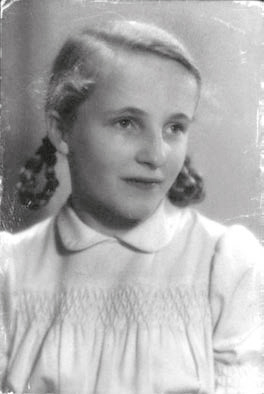
German Gabriele Kёpp, who was raped by Red Army soldiers when she was 15 years old. In 2011, she published her memoirs entitled “Why am I born a Girl?”

Robbery, looting, arson, violence against the civilian population and prisoners became widespread. For this reason, special orders from Soviet command along the fronts emphasized the inadmissibility of such behaviour and required the restoration of discipline in the army as soon as possible. The Directive of the Soviet High Command obliged “to change the attitude toward the Germans, both prisoners of war and civilians. Behave better toward the Germans.”

But these measures were clearly not enough. In late March 1945, a memorandum addressed to the Secretary of the Central Committee of the Communist Party of the Soviet Union, Malenkov, records the case of the mass rape of women by Soviet soldiers at the Nemmersdorf estate. These women were not even German. The document states that this estate was the temporary placement for the liberated “Ostarbeiter”! One of the official reports of the Main Trophy Administration of the Red Army included that among the “spoils of war” were thousands of pianos, hundreds of thousands of carpets, furniture and clocks.

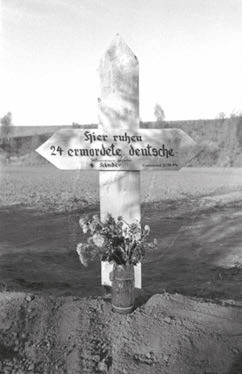
“Here lie 24 killed Germans”. Mass civilian grave in the city of Nemmersdorf in Eastern Prussia, where the Red Army killed Germans on 21 October 1944. Today, this is the village of Mayakovskoye, Kaliningrad province of Russia and there is no sign of a mass grave anywhere

In fact, the crimes of Soviet soldiers against civilians was so massive and irrefutable that they had to be accepted even in official Russian historiography. The President of the Association of Second World War Historians, O. Rzheshevskyj stated that in the first month of 1945 alone, for excessive behaviour against the local population, the tribunals convicted “4,148 officers and a large number of rank and file.”

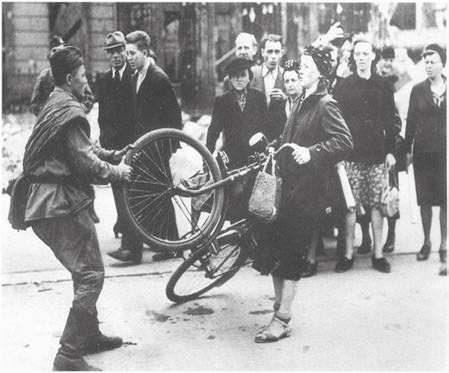
This photo, taken in August 1945 in Berlin, was published in “Life” magazine and captioned with the following: “A Soviet soldier struggles to take a woman’s bicycle in Berlin.”