Myth
45
The War Ended on 9 May
Yana Prymachenko
Zhukov, G.K. Memoirs and Reflections
“In the afternoon of 9 May, I received a call from Moscow and they informed me that all the documents about the surrender of Nazi Germany were received and given to the Commander-in- Chief. So ended the bloody war. Nazi Germany and its allies were finally defeated.”
■ The Essence of the Myth
The war for the Soviet Union ended on 9 May 1945.
■ Fast Facts
The anchoring of 9 May as the date of the end of the war into the minds of Ukrainian citizens is a result of the historical policy of the Soviet Union. In fact, for the USSR, the Second World War ended on 2 September 1945.
■ Detailed Facts
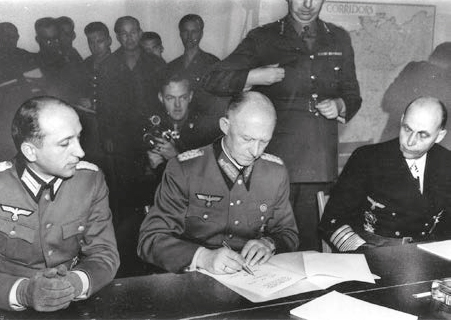
The act of unconditional surrender of Nazi Germany in Reims was signed on 02:41 on 7 May 1945.
The signing ceremony was attended by a group of journalists. However, at the request of the representative of the Soviet Union, Ivan Susloparov, the USA and Great Britain agreed to postpone the public announcement about the surrender so that the Soviet Union could prepare a second surrender ceremony in Berlin. The reporters promised to report on the surrender only 36 hours later, at exactly 3:00 on 8 May 1945.
However, German radio announced the signing of the surrender on 7 May at 14:41. Following this, an hour later, Edward Kennedy from Associated Press also reported it and set himself free of the promise to keep it a secret. However, Kennedy was fired from the agency and the continued silence of the surrender to the West lasted the entire day.
During the day of 8 May, the surrender of Germany was officially announced.
There was an absolute ban on broadcasting the news of the surrender on 7 May in the Soviet Union. The reason for that was that the Soviet representative, General Ivan Susloparov, signed the act in Reims without having a directive from Moscow. Kremlin instructions did not come in at the right time. Shortly after signing the act, General Susloparov, received a telegram with Stalin categorically prohibiting the signing of the surrender.
Stalin protested the signing of the surrender in Reims because the Western Allies played a leading role. The Soviet leader refused to recognize the act and demanded the signing of a new act of German surrender by the Red Army in Berlin and also – as already mentioned – to request that the Allies not officially announce victory until the second surrender comes into force on 9 May, Moscow time.
This request was refused by British Prime Minister Winston Churchill and American President Harry Truman. Churchill explained that he would need to inform Parliament. Truman said that Stalin’s request came in too late for him to cancel the Victory announcement. Stalin, in turn, said: “The act, signed in Reims, cannot be undone but it cannot be accepted. Surrender should be made as an important historical fact and signed not on the territory of the victors but where fascist aggression came from – in Berlin, and not unilaterally but necessarily with the Commanderin- Chiefs of all countries in the Anti-Hitler coalition.”
In response, the Allies agreed to a re-signing surrender ceremony in Berlin.
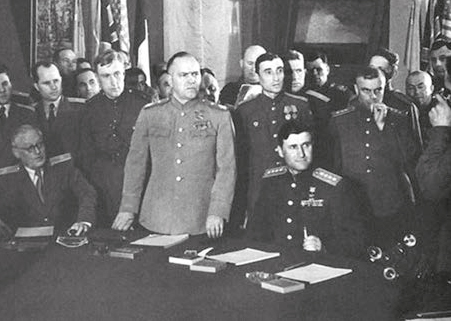
On 8 May at 22:43 Central European Time – or 9 May at 00:43 Moscow Time – in the Berlin suburb of Karlshorst, another German surrender was signed. The text repeated verbatim that from 7 May. The Karlshorst act confirmed the ceasefire specified in the Reims act at 8 May at 23:01 Central European Time.
The same day, the Presidium of the Supreme Soviet of the USSR issued a decree that announced 9 May as Victory Day.
Despite signing the surrender with Germany, fighting was still occurring along the front. The Germans did not want to surrender to the Red Army and tried to break out into the Western zones of occupation, at all costs. Therefore, the Nazis were finally expelled from Prague on 10 May and the last group of German troops in Czechoslovakia and Austria were expelled on 19 May.
Carrying out its obligations to the anti-Hitler coalition, the Soviet Union declared war on Japan on 8 August 1945. This war was seen as a direct continuation and part of the Great Patriotic War. On 2 September 1945, the day of Japan’s surrender, the Supreme Soviet of the USSR issued a decree which called 3 September Victory Day over militaristic Japan.
Both holidays – 9 May and 3 September – were declared national holidays. But in 1947, these were again declared work days.
Later, when the “Great Patriotic War” foundation was laid out in Soviet ideology, the emphasis was made on the victory over Germany. The point of this manipulation was to move the focus from “World” to the term “Great Patriotic” and thus divert public attention from other armed conflicts in which the Soviet Union acted as an aggressor during the Second World War: their attack on Poland, western Ukraine and Belarus, Finland and the Baltic States. The official name of the holiday was the “Holiday of the Victory of the Soviet People in the Great Patriotic War of 1941–1945.” In this way, the events of 1939–1941 when the USSR entered into an alliance with the Third Reich were removed from the focus of public attention and Nazi-Soviet cooperation was ignored.
Wehrmacht
General Jodl
signing the
German
Instrument of
Surrender, Reims
(7 May 1945)
In 1965, 9 May became a national holiday again with mandatory military parades in honor of the holiday. In this way, 9 May finally became fixed in the public consciousness as the Day of Victory and the date of the end of the war.
Formally, the war with Germany was over on 25 January 1955 by a decree from the Presidium of the Supreme Soviet of the USSR entitled: “On Ending the State of War between the USSR and Germany.”
Soviet delegation
at the signing
of Germany’s
unconditional
surrender on
8 May 1945 in
Berlin