
Myth
47
Victory Marshal
Rostyslav Pyliavets
Medynskyj, V.,
The War. Myths
of the USSR.
1939–1945
“Why does the commander-cannibal myth enclose its black shadow over Marshal Zhukov?…But Marshal Zhukov was the target for another reason, the unabated attacks on our victory. Simply our great XX century commander – is its symbol.”
■ The Essence of the Myth
Georgy Zhukov was a brilliant strategist, talented and the most effective among the Soviet generals during the war. Zhukov made the largest contribution to the victory over Germany and that is why he is called the Victory Marshal.
■ Fast Facts
Calling Georgy Zhukov the “Victory Marshal” is not just incorrect but also has no foundation. As a front commander during the war, he also suffered crushing defeats and military setbacks. Either in terms of battles conducted by him as commander of front-line operations or those which he planned as the chief of staff and as the representative of Supreme Command.
■ Detailed Facts
The myth of Zhukov as the Victory Marshal began to be formed during the Brezhnev era with the publication of the Marshal’s memoirs, Spohady i Rozdumy, in 1969, and after Zhukov’s death in 1974. The Zhukov cult reached its peak towards the end of the 20th century when in 1994, the military Order of Zhukov was created. A year later, in Moscow, next to Red Square, a bronze horse sculpture depicting the Marshal during the Victory Parade was unveiled.
Zhukov as a military leader and a man was an extremely complex and ambiguous figure, despite the lack of sufficient general and military education (four class school plus courses for cavalry commanders) and a low level of personal culture. He had a talent for military affairs, defined by his strong, cruel and uncompromising will and the ability to direct all his efforts towards his goal. On the other hand, he was described as a ruthless and cruel man who carried out unjust actions and deeds, towards his subordinates.
It is difficult to accuse him of cowardice. He was often on the front, where he would sometimes personally “give an order.” At the same time, he did not contemplate the losses, did not respect his soldiers’ lives but because of them he received his position in the pantheon of Soviet generals and commanders of the Second World War as “the star of the first magnitude.” Along with his failures and a crushing defeat, he owned his achievements in successful Red Army operations. But this success was often achieved not by high-level military prowess but repeated advantages in strength and capability.
He was far from an all-round strong and honest man. He was not devoid of the Napoleon complex. He took credit for other people’s achievements and services. And he had a weakness for material things and luxury.
Particular pieces of evidence go against Zhukov’s prominent role in the war. Criticism of his working methods, allegations of large losses and his boorish attitude toward his subordinates can be found in the memories of many marshals, generals and war veterans. Sometimes this was because of jealousy of his fame or personal insults but mostly these were objective accusations.
After the German attack on the USSR, being the chief of the general staff of the Red Army and a member of the main high command, Zhukov was sent to as a representative of the STAVKA to repel the enemy in the southwest, and then on the western front. However, his counterattack did not improve the situation and led to the defeat of his troops. The Red Army retreat turned into a flight. There were colossal losses in manpower, weapons and military equipment. Therefore, Zhukov lost one of several tasks assigned to him.
In late July, he was removed from the position of chief of general staff and appointed commander of the Reserve Front. Only Stalin’s personal commitment saved Zhukov from repeating the fate of the western front’s commander colonel-general Dmitry Pavlov, who was executed together with a group of other generals.
From October 1941 to August 1942, Zhukov commanded the western front. In 1942, it was a year of brutal defeats and huge losses. Zhukov conducted continuous offensive operations, which ended in failure. The total losses in the Rzhev-Vyazma offensive amounted to about 777,000 people, nearly 75 percent of troops before the operation. This was the bloodier of the two Rzhev operations which occurred in August and November-December 1942.
But even after this failure with heavy losses and performances under Rzhev and Sychyovka, Stalin appointed Zhukov as deputy supreme commander and first Deputy of the People’s Commissar of Defence in late August. At the same time as the representative of the STAVKA, he steered the Stalingrad area. And although Zhukov’s results were very modest, in January 1943, for his personal achievements he was awarded the first ever Marshal of the Soviet Union title.
Another ugly page in the biography of the Marshal was Operation Polar Star, (February-April 1943). After breaking the siege of Leningrad, he planned to defeat the German Army Group North, liberate the Leningrad region and create conditions for a successful offensive in the Baltic States. But the operation ended in failure and Soviet forces suffered heavy losses.
Marshal of the
Soviet Union
Georgy Zhukov
during a parade
in Red Square
(24 June 1945)
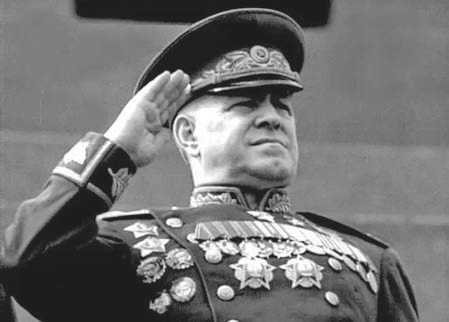
After the death of Vatutin, Stalin ordered Zhukov to lead the 1st Ukrainian Front. On 10 April 1944, for the liberation of Ukraine, Zhukov was awarded the highest military award, the Order of Victory No. 1.
In the summer of 1944, Zhukov coordinated the operations of the 1st and 2nd Belarussian Front in the Bagration Operation. Zhukov appropriated to himself the major achievements in carrying out successful operations which resulted in the enemy being cleared from the territory of Belarus, and effectively deprived others, particularly the command of the 1st Belarussian Front, Konstantin Rokossovsky, of any fame.
In late March 1945, with Stalin’s light hand Zhukov was the first to receive the second Order of Victory, “for the skillful tasks of the Supreme Command.” Later, two gentlemen were added to the cohort and given the highest military award – Marshal Vasilevsky and Stalin himself.
The apotheosis of military glory for Marshal Zhukov became the Battle for Berlin. On 16 April, he as the commander of the 1st Belarussian Front, began his offensive, unprecedented in scope and rapidity. However, it also resulted in a large amount of losses. According to official and clearly underestimated data, the Red Army in its Berlin operations lost 352,000 people, including more than 78,000 killed. The size of the daily losses of personnel and equipment (over 15,000 people, 87 tanks and SPGs, 40 planes) during the Battle for Berlin, exceeded all other Red Army operations, where the losses were the result of fights, unlike the first battles of the war when the daily loss of Soviet troops was mainly through a significant number of prisoners. The intensity of these losses, this operation was only comparable to the Kursk battle.
Perhaps, for his “achievements”, Georgy Zhukov is called the “unsurpassed national commander” of all time, who “highly exalted the glory of Russian arms” in modern militarized Russia.







