Myth
48
Hero Cities
Maksym Maiorov
Resolution of the
Presidium of the
Supreme Soviet of
the USSR on the
Honorary Title
'Hero City',
8 May 1965
“The title of ‘Hero City’ is given to the cities of the Soviet Union, whose workers’ displayed heroism and courage in defending the Fatherland during the Great Patriotic War of 1941–1945.”
■ The Essence of the Myth
Some cities of the USSR, which particularly distinguished themselves during the war, gained national recognition as hero cities.
■ Fast Facts
Awarding the honour of Hero City occurred haphazardly, candidates were selected based on the subjective opinion of the Soviet leadership and not on the city’s combat contribution to the victory.
■ Detailed Facts
The phrase Hero City was originally used as a metaphor. In 1942, Pravda newspaper used “hero city” to describe Leningrad, Odesa, Sevastopol and Stalingrad. On 1 May 1945, Stalin ordered the capitals of 16 republics, and the four “hero cities” to hold a salute: Leningrad, Stalingrad, Sevastopol and Odesa. In the decree establishing the medal ‘For the Defence of Kyiv’ in 1961, the capital of Ukraine was also named a hero city.
What is a “hero city” and what kind of city can earn the title?
It was first identified in 1965. For the 20th anniversary of the victory over Germany, the Presidium of the Supreme Soviet of the USSR approved the relevant resolutions. The title of Hero City was given to cities across the USSR that showed “courage and heroism” during the war.
How exactly does one determine the extent of heroism? The resolution does not say. No special commissions were created for this. The decision was based on the sole discretion of the Presidium of the Supreme Council.
The value of the Hero City was part of the active cultivation of the myth of the Great Patriotic War (more on this in Myth 46). The first award was given 20 years after the war. It was given to 6 cities: Leningrad, Odesa, Sevastopol, Volgograd (formerly Stalingrad), Kyiv, Moscow and later to the Brest Fortress.
In the 1970s, Kerch, Novorossiysk, Minsk and Tula also became hero cities. The final awards were given to Smolensk and Murmansk in 1985, to mark the 40th anniversary of the war.
In total, there were 12 hero cities and the Brest hero fortress.
Even in the USSR, people noticed that this award process was not always fair. Many residents of different cities and villages were involved in the victory over Germany, and not only those along the front lines. The rear supplied recruits, welcomed evacuated specialists and industrialists. But no rear cities received any stars. Attention was focused on those cities where fighting occurred.
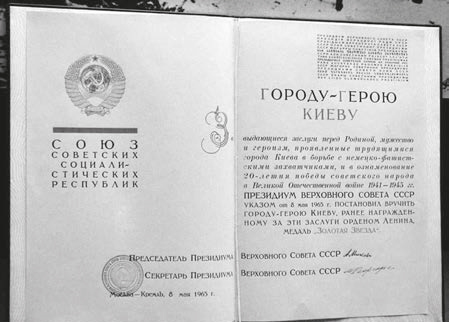
Diploma from the Presidium of the Supreme Soviet of the USSR from 8 May 1965 “On Awarding the Hero City Kyiv the ‘Gold Star’ Medal”
However, the successful defence of cities depended not only on the heroism of their defenders. There were many important operational and strategic factors, geographical features, troop numbers involved in the fighting. The combination of these adverse factors allowed the successful defence of Leningrad, Odesa, Sevastopol and Moscow. For many other settlements the situation was hopeless.
Despite this heroic resistance, the hero cities of Odesa, Kyiv, and Sevastopol were lost to the enemy. Kyiv fell after an impressive encirclement of the armies along the southwestern front. The defenders of Sevastopol were left to their fate by their command at a critical moment. The miscalculations of planning the first landings on the Kerch Peninsula ended in tragedy. Almost every case of heroic defence did not occur without some shameful defeats and examples of inappropriate behaviour from their leadership.
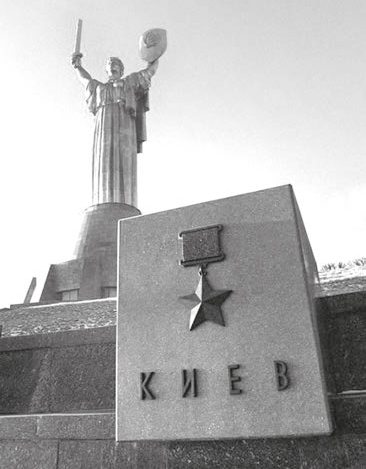
The “Kyiv Hero City” monument at the National Museum of the History of Ukraine in the Second World War
Minsk, Kerch and Smolensk were captured instantly by the Germans. The defence of each of these cities did not last a week.
Minsk became a Hero City only in 1974, as the capital of the “partisan-republic.”
Kerch, like Novorossiysk, was awarded the title in 1973 for the 30th anniversary of the German defeat in the North Caucasus and the Crimea. The key to why this city was chosen is simple: Leonid Brezhnev, the General Secretary, fought near Novorossiysk.
Smolensk was eventually recognized as a hero city after the persistent requests of the local regional party. Their justification was that Smolensk has long been known as the gateway to Moscow. It did not matter that these gates were defective in 1941. Tula also awarded the title by the persuasion of the Soviet leadership.
A number of truly heroic cities did not receive any stars. For example, there were numerous unsuccessful attempts for Voronezh to be awarded the title. This pre-front city hampered the enemy longer than Stalingrad and was also not captured.
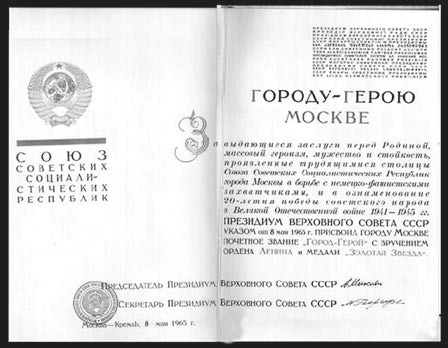
Decree from the Presidium of the Supreme Soviet of the USSR from 8 May 1965 “On Awarding Moscow the Honourary Title of ‘Hero City’”
Brezhnev refused to recognize Kursk as a hero city, even though the Battle of Kursk received international recognition.
The counterattack on Rostov-on-Don in the autumn of 1941 was one of the first, (besides the Kerch landing), to be successful. But the Rostov region, as the successor of the Don Cossacks, had a reputation as being unreliable and was not awarded the title.
There were four great battles for Kharkiv between 1941– 1943. The city passed from hand to hand three times. Meanwhile, feats in these battles worthy of the hero stars, where not awarded by the Soviet leadership.
What was the reason for this selectivity?
Formally, the award was only symbolic but in reality it meant access to certain privileges. The Hero City Administration received generous material resources, including better commodity security. Obligatory material bonuses that were given to Hero Cities significantly limited the generosity of the Communist Party.
The Soviet Union could not feed that many heroic cities. Therefore, the celebration was dragged on for decades and not all worthy places were awarded.