
Myth
49
Russia Could Defeat the Nazis Even Without the Ukrainians
Yana Prymachenko
Then Russian
Prime Minister
Vladimir Putin
during the TV
Conversation with
Vladimir Putin.
Continued,
16 December 2010
“If we look at the statistics from the Second World War, then it turns out that the greatest losses in the Great Patriotic War were in the RSFSR. More than 70 percent of the losses. This means, the war was won, I don’t want to offend anyone, mainly due to the human and industrial resources of the Russian Federation.”
■ The Essence of the Myth
The Russian people bore the brunt of the war.
■ Fast Facts
Victory over Nazism in the Second World War was not the result of the actions of any one country but rather the joint actions of all participants in the anti-Hitler coalition. Therefore, even the question of a “sovereign victory” by one country is absurd: the combination of each of these countries was important. At the same time, the Ukrainians in this remark have been unfairly diminished.
■ Detailed Facts
Where did the statement that the “RSFSR made up 70 percent of the losses in the Great Patriotic War” come from?
The official position of the Kremlin relies on estimates of Russian military historians, according to which between 1941–1945 there were 34.5 million Soviet citizens in the Red Army and Navy. The total losses amounted to 8,668,400 out of which, 1,376,000 Ukrainians (therefore 15.9 percent of the total military casualties of the USSR or more than all the losses of the USA, Great Britain and Poland combined).
In fact, as calculated by independent historians, the military losses of the Soviet armed forces fluctuated between 11–12 million, of which approximately 2.5 million were Ukrainian, thus 21–22 percent.
However, everything depends on how one counts: by ethnicity or territory.
Russian military experts calculate their figures based on ethnicity and automatically ignore citizens of other nationalities (Russians, Belarussians, Poles, Jews, Germans, Tatars, Moldovans, Armenians, Greeks and others), whose grandfathers and great-grandfathers lived in Ukraine, for whom this land was home. Since Ukraine was always multinational, this approach and its reasons for its usage, leave many questions.
The use of this ethnic approach reduced the non-Russian peoples share of losses to 33.7 percent.
According to estimates of Ukrainian researchers, nearly 7 million people from Ukraine fought in the Red Army, thus they made up approximately 23 percent of the total armed forces of the USSR.
The number of Ukrainian citizens in the Red Army constantly changed throughout the war. In 1941, they accounted for 15–20 percent (second only to Russians). In 1942, the Ukrainian share decreased in the Red Army: many were taken prisoner or were on occupied territory. In early 1944, during the liberation of Ukraine, the number of Ukrainians increased to more than 22 percent.
Commanding
unit of the 1st
Ukrainian Front
in ceremonial
dress during a
parade on Red
Square
(24 June
1945)

Between 1944–1945, the share of ethnic Russians in some armies of the Soviet army was only about 40 percent, for example, the 60th Army of the 1st Ukrainian Front, who liberated Auschwitz and Krakow, was composed of 36 percent Russians and 32 percent Ukrainians.
This became known during the scandal in the winter of 2015. The Russian Ministry of Defense was upset when the Polish Minister of Foreign Affairs, Grzegorz Schetyna, said that “Ukrainians liberated Auschwitz.” Finally the national composition of this military component was declassified (70 years after the war!). Quite accidently therefore, the Russian Minister of Defense contradicted the words of Vladimir Putin’s statement about the 70 percent loss to human resources.
One should also not forget about the quality of the indicators. About 2.5 million Ukrainians were awarded Soviet orders and medals. For exceptional courage, 2,000 were awarded the title of Hero of the Soviet Union. The Hero of the Soviet Union was awarded to I. Kozhedub three times, a further 32 Ukrainians were awarded it twice including A. Molodchy, D. Glinka, P. Taran, M. Bondarenko, O. Mazurenko, A. Nedbaylo, V. Mykhlyk and others.
Many Ukrainians were part of the Red Army command: G. Kulik, S. Tymoshenko, I. Chernyakhovsky, A. Grechko, A. Yeremenko, K. Moskalenko, P. Zhmachenko and R. Malinowski.
On behalf of the USSR, the Japanese Instrument of Surrender was signed by the Ukrainian General K. Derevianko.
The group who raised the so called “Victory Flag” over the Reichstag was headed by the Ukrainian lieutenant O. Berest.
The international recognition of the Ukrainian contribution of the victory over Nazism was granted by UN membership to the Ukrainian SSR.
Supporters of the ethnic approach in assessing the contribution of Ukrainians to the victory over Nazism should be reminded of some important facts.
For Ukrainians, the war did not begin in June 1941, but rather on 1 September 1939. At the beginning of the Second World War in the Polish Army, which totaled 1 million people, approximately 120,000 ethnic Ukrainians served. During the September campaign in the battles against the Nazis, 8,000 Ukrainians were killed who were citizens of Poland.
Ukrainians fought in the Allied armies. This fact, is in contrast to the Ukrainian service in the ranks of the Wehrmacht and SS troops, on which some Russian historians remain silent.
Among the US military, there were 40,000 Americans of Ukrainian descent who participated in Operation Overlord (the landing of Allied troops in Normandy). The number of Ukrainians in the Canadian Army, according to various sources, ranged from 35 to 50,000.
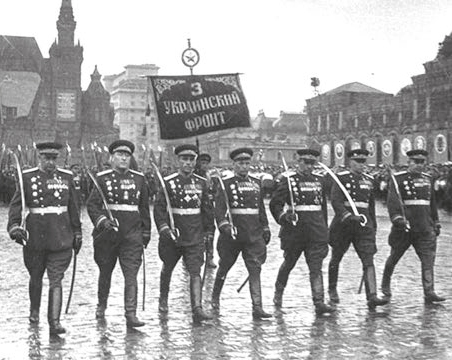
Commanding
unit of the 3rd
Ukrainian Front
in ceremonial
dress during a
parade on Red
Square
(24 June
1945)
From 1940, five thousand Ukrainians fought in the French Foreign Legion. In 1944, the French resistance movement had three separate Ukrainian units.
Thousands of ethnic Ukrainians, former Polish citizens, who after 1939 were deported to the eastern regions of the USSR, joined the 2nd Polish Corps under General Wladyslaw Anders. In 1942, the Corps left the territory of the USSR and as part of the British expeditionary troops, took part in battles in Italy.
In the summer of 1943, the 1st Czechoslovak Separate Brigade was formed and commanded by Colonel Ludwig Svoboda. Out of the 15,000 personnel, 11,000 were Ukrainians from the Carpathian region.
A few words are also worth mentioning in this context about the evacuated human resources and industrial capacity from the Ukrainian territory. It is hard to imagine a common victory without the Ukrainian metallurgical and engineering companies and Ukrainian experts who built tanks and planes in the southern Urals.
Most importantly, what escapes Putin’s attention is a fair assessment of the joint effort of the anti-Hitler coalition. Without the American Lend-Lease, victory would have been impossible in Eastern Europe. Lend-Lease was not possible without successful military operations in the Pacific theater. Therefore, the success of the many victories of the Red Army are directly dependent on US military efforts across the globe. And this is only one example of a similar matter. No one can really say whose help or whose efforts in the war were so decisive.
Putin’s words are an example of manipulation of facts and instrumentation of history, deliberately narrowing people’s perspective.







