
Myth
50
“No one is Forgotten, Nothing is Forgotten”
Viktoria Iaremenko
Olga Bergholz,
Piskaryovskoye
Memorial in
St.
Petersburg, 1959
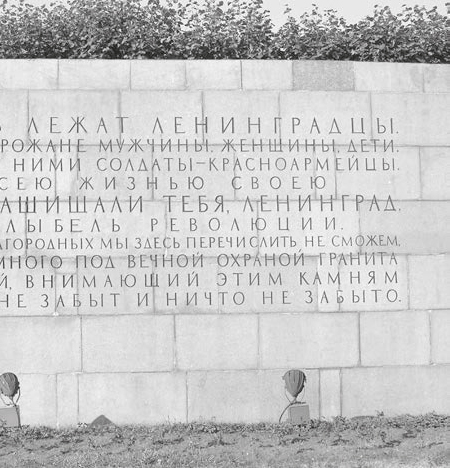
“There lay Leningrad people.
There are citizens – men, women, children.
Next to them, Red Army soldiers.
With all their lives
They defended you, Leningrad.
Cradle of the Revolution.
Their names are precious
Here we enumerate no one.
Many of them are under the eternal granite guard
But know, hear these stones,
No one is forgotten, Nothing is forgotten.”
■ The Essence of the Myth
The phrase “No one is forgotten, Nothing is forgotten” is the main propaganda slogan of the Soviet post-war period, the appeal-oath that concerns perpetuating the memory of Soviet citizens who died during the so-called Great Patriotic War. This was first used in a poem by Olga Bergholz in 1959. It is written on the memorial slate in Piskaryovskoye Memorial, where the victims of the siege of Leningrad are buried.
■ Fast Facts
The list of the victims of the war, which were honored in the USSR, was not complete for a long time. Among those forgotten were the prisoners of war, the disabled veterans, the victims of the Holocaust, the Ostarbeiter and the members of the so-called border conflicts. Lastly, are the events before 22 June 1941. Similarly, the defeat of 1941–beginning of 1942 is forgotten. Even Soviet sanctuary – the graves of Soviet soldiers – suffered from neglect. Amalgamation has occurred, graves have been transferred and soldiers’ names lost.
■ Detailed Facts
The “Great Patriotic War of the Soviet People against the German-Fascist Invaders” was the main myth of the Soviet Union in the postwar period. This image of the war appeared as a heroic feat of only the Soviet people headed by the ruling party. The expression “No one is forgotten, Nothing is forgotten!” was another propaganda slogan. The official memory ignored many facts and inconvenient victims.
Even during the war, the Soviet leadership launched a process of perpetuating the memory of heroes and memorable events. In Ukraine, soon after the expulsion of the Nazis from Kyiv, the generals of the defense of the capital were buried: Kirponos, Potapov, Tupikov. In 1957, they were reburied in Glory Park. It was designed as a place to honor the heroes of the Great Patriotic War with an Eternal Flame and the Tomb of the Unknown Soldier.
During 1943–1944, the Central Commission of the Ukrainian Communist Party prepared a large-scale plan to erect a monument to the liberators. This was never built. However, until 1 October 1947, the Ukrainian SSR streamlined 31,688 collective and 64,670 individual Soviet soldier graves, created 2,613 monuments, 9,861 tombstones and 52,549 tomb signs.
It seemed to the Soviet public that no one is forgotten, nothing is forgotten. However, researchers have highlighted a negligent attitude towards the military burials. By the late 1950s, a consolidation of graves occurred. They were transferred and the names of the victims were lost.
They did not find room for Soviet prisoners of war in any versions of the victory. Other researchers approximated their numbers from 4.5 million to 5.75 million. The Germans killed at least half a million Soviet prisoners of war. Hunger and the inhuman conditions of their detention and transportation killed another 2.6 million prisoners.
The majority of those mobilized during the war were permanently disabled as a result. After victory, they were left to random counterfeiting and begging. All these people were an inconvenience to the authorities. In 1949 in places far from the central cities, Soviet authorities organized nursing homes. Many former soldiers were forced into these homes. They were held as prisoners. Officially, the authorities did not mention them.
Driving the war count on 22 June 1941, the Soviet Union acknowledged a series of events which did not fit into the overall heroic canon. The Battles of Khalkhin Gol, the socalled Golden September of 1939, the Soviet-Finnish war, the occupation of western Ukraine and Bessarabia, the socalled border conflict with the Baltic States. The participants of these were dropped from the privileged position of “veterans of the Great Patriotic War” and were considered “participants in the border conflict.”
Soviet propaganda “forgot” about a number of defeats between 1941–beginning of 1942. For the catastrophe of 1941, Soviet historians found a euphemism, they described it as a “period of temporary setbacks,” due to the “infidelity of the German attack” and the predominance of the enemy.
Piskaryovskoye
Memorial in
St. Petersburg,
which bear’s Olga
Bergholz’ words
There was also a silence over the ethnic composition of partisan units and the Red Army. All of this supported the myth of the brotherly nations of the USSR as one of the elements of victory. Out of the spotlight was the problems of international relations and national minorities during the war.
These taboos included the deportation of Crimean Tatars and German Ukrainians, the Ukrainian-Polish conflict and even the Holocaust tragedy. The prohibition/displacement of the memory about the Jewish catastrophe was due to the reluctance of the Soviet authorities to view the Jews as the greatest victims of the Nazi occupation. Numerous Jewish burials, their places of mass executions on Ukrainian territories were called graves of “peaceful Soviet citizens, victims of the Nazi occupational regime.” Only during Perestroika, did the voices of the Jewish victims begin to be heard. Another unpopular theme was the occupation of Ukraine, the Ostarbeiter problem and also the Ukrainian liberation movement, who fought both the Nazis and the Communists.
Above all, the Soviet authorities also did not want to establish the exact number of the victims of the war. Immediately after the war, the Soviet Union announced they lost 7 million. Later, however, the figure of 20 million was exploited. Before the collapse of the USSR, the number of casualties rose to 27 million. The exact number of victims has still not been established to this day. The systematic accounting of losses were not even from the military. A huge number of dead still lay unburied in old trenches.







