 By Volodymyr Viatrovych
The US National Archives’ new report on the CIA’s complicity in protecting Nazi war criminals during the Cold War, including alleged Ukrainian war criminals, is shockingly similar to something that the Soviet KGB could have cooked up.
While the authors of the report, Richard Breitman and Norman J. W. Goda, both historians, have performed a great service in shedding more light on the CIA’s cooperation with former Nazis, their attempt to expand the list of war criminals to include Mykola Lebed, a leader of the Organization of Ukrainian Nationalists, raises serious concerns about their objectivity and motives.
On 10 December 2010 the National Archives in Washington, D.C. issued a report for the US Congress with a dramatic title “Hitler’s Shadow: Nazi War Criminals, U.S. Intelligence and the Cold War.” Relying on newly declassified documents, historians Richard Breitman and Norman Goda accuse the postwar American secret services of protecting Nazi war criminals.
Clearly, the report’s release comes at a time when a heated information war is taking place in Ukraine and Russia about history. Ukrainians’ efforts to rethink their recent history and bring to light its unknown pages through the declassification of former KGB archives, have encountered a sharp rebuke from neighboring Russia. Russia’s highest-ranking leaders, including the president and the prime minister, regularly issue statements that seek, sometimes rather coarsely, to correct Ukrainians’ views of their own history. Nowhere is this Soviet-style revisionism more apparent than in questions relating to the national liberation movement led by the Organization of Ukrainian Nationalists (OUN) and the Ukrainian Insurgent Army (UPA) during and after the Second World War.
 The key element in Soviet propaganda has been the depiction of the Ukrainian insurgents as Nazi collaborators. The fall-out from this insidious propaganda is still being felt today: it crops up in North American and Western European media, as well as in studies of professional historians—this, despite the fact that thousands of Ukrainian, Soviet, and German documents recounting the anti-Nazi struggle of the OUN and the UPA have come to light after the collapse of the USSR.
One example of the resurfacing of this propaganda can be found in “Hitler’s Shadow,” the report written by R. Breitman and N. Goda and published by the US National Archives. This is not the first time these authors have labeled a key figure in the OUN, Mykola Lebed, a Nazi war criminal. Their earlier attempt, the 2005 report “US Intelligence and the Nazis” also published by the National Archives, as well as the present book, omits all mention the declassified former Soviet Union archival material that gives a different story.
Breitman and Goda argue that the American secret services collaborated with Lebed, a “Nazi war criminal.” Their logic is as follows:
- The OUN, a pro-fascist organization and ally of the Nazis, took part in the mass liquidation of the Jews.
- Mykola Lebed was a leading member of the OUN.
- The CIA collaborated with Lebed during the postwar period.
- The CIA protected Nazi war criminals, including Lebed.
The main thrust of this logical construct is in the first point, a statement that should be based on solid sources and corroborated with authentic OUN documents and also declassified archival documents from the former Soviet Union. Breitman and Goda should have also looked at the mass of documents and studies published in the last 20 years in Europe. Here they would find little support for the allegation about OUN collaboration with the Nazis. By contrast, they would find documentary evidence of the KGB falsifying the history of the OUN in order to compromise it.
Between 2008 and early 2010 Ukraine opened up the KGB archives it possessed. Ironically, even if KGB archives in Russia are still under lock and key, what is available in Ukraine today is sufficient for historians to reach certain conclusions. Regrettably, the authors of the National Archives publication neither examined nor mentioned these published documents. Thus it is hardly surprising that their opinions are very similar to Soviet-era propaganda.
It is not clear how Lebed’s name can appear for a second time in a list of notorious Nazis, including Hitler’s personal secretary Gertrude (Traudl) Junge; Gauleiter Arthur Greiser; Grand Mufti of Jerusalem Haj Amin al-Husseini; and the top leaders of the Gestapo, including Adolf Eichmann. By including Mykola Lebed in the company of these Nazi war criminals and anti-Semites, the authors try to convince us that Lebed was unquestionably also a collaborator and Nazi war criminal.
The authors present a facsimile of a CIA document from 1952 with a caption: “The CIA moved to protect Ukrainian [sic] nationalist leader Mykola Lebed from criminal investigation by the Immigration and Naturalization Service in 1952.” In the context of the entire National Archives report, readers may conclude that the Central Intelligence Agency was trying to protect their protégé from accusations stemming for his part in Nazi war crimes. However, as the contents of this document indicate, the US Immigration and Naturalization Service was investigating Lebed’s involvement in the 1934 assassination of Poland’s Minister of Internal Affairs Bronisław Pieracki, who had instituted a series of brutal anti-Ukrainian policies.
Information on Lebed is mostly on his postwar collaboration with the American secret services. And here the authors provide almost no context and have not scrutinized the veracity of cited informant documents. With regard to the Second World War, the very period when Lebed had supposedly shown himself to be a Nazi war criminal, the authors refer to only secondary literature. They are suspiciously silent about primary sources.
The authors do write about the arrests and murders by the Germans of Ukrainian nationalists who were accused of organizing an anti-Nazi uprising. They characterize the relationship between the Nazis and the OUN as “complicated.” They also mention the Gestapo’s efforts to arrest or liquidate Mykola Lebed. They could of also said that Lebed’s wife Daria and their eighteen-month-old daughter Zoriana were sent to the Ravensbrück concentration camp. But this would be odd grounds for regarding Lebed to be on par with the likes of Eichmann.
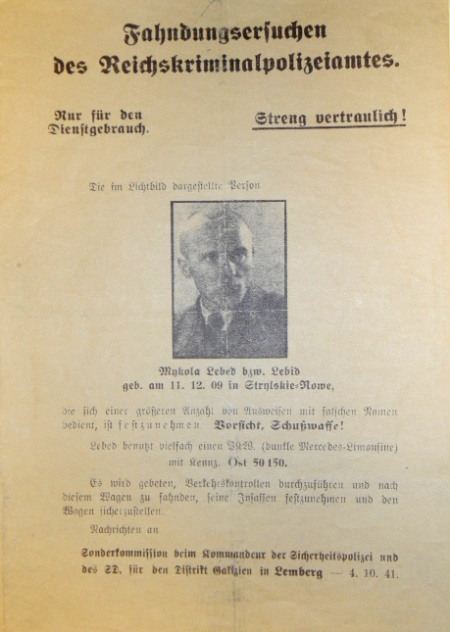
Mykola Lebed’s archive can be found at Harvard University. It contains his personal papers and more than one thousand documents from the 1940s–1950s issued by the OUN and the UPA. This collection sheds light on the ideology of these two structures, their attitude to various national groups and their struggle against the German occupation, and the causes and course of the Polish-Ukrainian conflict of 1942–47. Citing only a fragment of one document and ignoring the relevant parts of the full text, as Goda has done to make the OUN into an anti-Semitic organization, is a serious breach of professional ethics.
Incidentally, among the documents housed at Harvard are copies of publications about the “Nazi war criminal” Mykola Lebed, which were concocted by the KGB in the 1970s and 1980s. Perhaps the National Archives and Records Administration might have been more critical of what it received from historians, who’s agenda seams to be a revival of the KGB’s shadow and old communist myths.
Volodymyr Viatrovych
Senior visiting scholar, Ukrainian Research Institute, Harvard University
Volodymyr Viatrovych is a historian specializing in the history of the Ukrainian liberation movement. In 2008–10, when he was the director of the Branch State Archive of the Security Service of Ukraine (HDA SBU), he helped to declassify previously secret KGB archives, making them accessible through a specially created network of research centers. He is the author of several books and numerous articles about the Ukrainian liberation movement in the twentieth century.