
Myth
21
Panfilov’s Twenty-Eight Guardsmen
Vasyl Pavlov
Krasnaia Zvezda Newspaper, 28 November 1941
“Over fifty enemy tanks moved along the lines which held the Panfilov Division’s Twenty-Nine Guardsmen… Only one of the twenty-nine was faint of heart… Only one raised his hand… Several guardsmen simultaneously, not saying a word, without a command, shot the coward and traitor… All twenty eight laid their heads. They were killed, but did not let the enemy pass.”
■ The Essence of the Myth
On 16 November 1941, near the Dubosekovo station, 28 Soviet soldiers of different nationalities – Russians, Ukrainians, Kazakh, Kyrgyz – entered into a battle against 50 German tanks, who were pushing against Moscow. The company’s political instructor V.G. Klochkov, encouraged the fighters to fight and said in immortal words: “Russia is a vast land, yet there is nowhere to retreat – Moscow is behind us!” During the battle, almost all of the heroes died but the cost of their lives destroyed 18 enemy tanks and hundreds of Nazis.
■ Fast Facts
The history of the Panfilov’s 28 Heroes was invented by the employees of the Krasnaia Zvezda newspaper. After the series of publications in the press, a decree of the Presidium of the Supreme Soviet of the USSR awared the title Hero of the Soviet Union, posthumously, to the 28 Guardsmen on 21 July 1942. The events of the “Victory of Panfilov’s 28 Heroes” became part of the canonical Soviet mythology of the Great Patriotic War. Panfilov’s story is widely present in the Soviet, Russian and also Kazakh and Kyrgyzstan state ideology: books have been written about them, films made, monuments erected in their honor, streets and parks named after them, and they’re mentioned in the hymn of Moscow.
■ Detailed Facts
In late November 1941, the newspaper Krasnaia Zvezda published an editorial called “The Testament of 28 Fallen Heroes” on the heroism of the soldiers in General Panfilov’s Division, which destroyed about two dozen German tanks and gave their lives to stop the advancing Germans to get to Moscow: “Over fifty enemy tanks moved along the lines which held the Panfilov Division’s Twenty-Nine Guardsmen… Only one of the twenty-nine was faint of heart… Only one raised his hand… Several guardsmen simultaneously, not saying a word, without a command, shot the coward and traitor.” Further it stated that the 28 guardsmen destroyed 18 enemy tanks and “all twenty-eight laid their heads. They were killed, but did not let the enemy pass.”
The author of the work, literary editor of the newspaper, A. Krivitsky, did not mention any of the hero’s last names. Of course, this remarkable feat could not remain nameless and two months afterward, in the same Krasnaia Zvezda newspaper, and in another article by Krivitsky titled “On the 28 Fallen Heroes,” was published with the names of the guardsmen killed. The author of the article included the name of the political officer, Klochkov, and described the battle:
“The attack of the guns was reflected back. Over seventy enemy bodies lay near the trench. The faces of the tired soldiers were smoky with gunpowder, lucky people who worthily engaged their forces with the enemy but they did not know their fate, not knowing what mainly lay ahead. Tanks! Twenty armored monsters moved to the line that was being defended by twentyeight guardsmen. The soldiers looked at each other. They expected an unequal battle. Suddenly, they heard a familiar voice: ‘You were healthy, heroes!’ The company’s political instructor Klochkov came into the trench…On that day, Klochkov first noticed the direction of the tank column and hurried along the trench. ‘Well, my friends?’ – said the political instructor to the soldiers. – Twenty tanks. Less than one per brother. That’s not that much!’ People smiled…The battle lasted over four hours. Already fourteen tanks were frozen motionless on the battlefield. Sergeant Dobrobabin was already killed, soldier Shemiakin was killed…Konkin, Shadrin, Timofeev and Trofimov were dead… Klockhov’s inflamed eyes looked at his comrades. “Thirty tanks friends – he said to his men – all of us will have to die perhaps. Russia is a vast land, yet there is nowhere to retreat – Moscow is behind us.” All the circumstances of the battle, including the legendary words of the political instructor that were mentioned in the article, were allegedly retold by the only surviving soldier of this battle, I. Natarov, before his death in a hospital.
After the articles on this story were published, Krivitsky spoke about it across the whole country. Like the heroism of Nikolai Gastello and Zoya Kosmodemyanskaya, everyone knew of the Panfilov heroes. Soon after, on 21 July 1942, at the request of the Western Front command, they were all posthumously awarded the title of Hero of the Soviet Union.
Throughout the whole war and two years after it, almost no one doubted the veracity outlined in the Krasnaia Zvezda story on the circumstances of the battle, until there was one event that forced the military prosecutor’s office to investigate.
From where the myth began. The first report about the “feat” of Panfilov’s 28 Guardsmen in the “Krasnaia Zvezda” newspaper from 28 November 1941
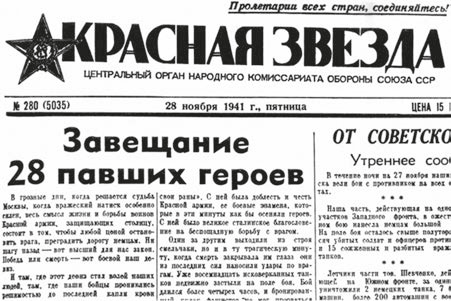
Everything began to fall apart in the autumn of 1947: in the Kyrgyz town of Kant the Ministry of State Security (MGB) arrested Ivan Dobrobabin on suspicion of collaborating with the Nazis. During his detention, Dobrobabin told the authorities that he was one of the 28 Panfilov heroes, presenting as his evidence a book about the dead guardsmen where a description was written about him. After this, Dobrobabin was moved to Kharkiv and the Military Prosecutor of the Kharkiv Garrison began to study the circumstances of the case.
The Prosecutor’s investigation found that Dobrobabin was in fact in the 4th Company of the Panfilov Division during the 16 November battle near Dubosekovo but, as he himself said, “did not commit any exploits and everything that was written about him in books about the Panfilov heroes is false.”
And this is not all. In the Prosecutor’s investigative report, it stated: “…that, apart from Dobrobabin, survivors included Ilarion Vasileev, Grigory Shemiakin, Ivan Shadrin and Danil Kuzhubergenov who also appeared in the list of 28 Panfilov men who died in the battle with German tanks. Therefore, it is necessary to investigate the circumstances of the battle.”
Monument dedicated to Panfilov’s 28 Guardsmen in one of the furthest places away from their “heroism”, Almaty (Kazakhstan). It is inscribed with words that Klochkov, the political instructor, never said
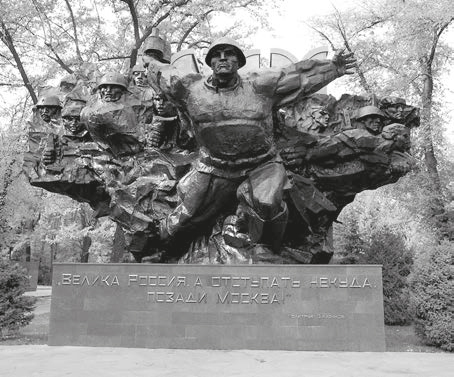
Dobrobabin, although he did not consider himself a hero, then told investigators the medley of his strange and twisted fate. During the battle on 16 November he was wounded and covered with earth. The German command found him and took him prisoner. After Dobrobabin fled or was released by the Germans, he reached his native village in the Kharkiv province and there, joined the police. With the arrival of Soviet troops, he was arrested. The Germans, who re-occupied the village, then released Dobrobabin. He again joined the police but with the front line approaching, he fled to the Odesa region. In March 1944, Ivan was re-mobilized back into the Red Army where he stayed until the end, was awarded for his service twice, demobilized and went to live in Kyrgyzstan, where he was arrested.
The investigating prosecutors did not try to conceal the details of the case or stop the investigation. They carefully questioned all the participants of those distant events, who were still alive, in particular – the former regimental commander I. Karpov, the former head editor of Krasnaia Zvezda, General D. Ortenberg, the author of the article A. Krivitsky.
Facts began to emerge which were undesirable for a broad disclosure. The newspaper version of the Panfilov Division was threatened by actual history. After the completion of the Prosecutor’s investigation, the detailed events of the autumn of 1941 were reconstructed.
Everything began with a trip of the Krasnaia Zvezda’s correspondent, Koroteev, to the headquarters of the 16th Army Division. There, he met with the Commissar of the 8th Guards Panfilov Division, Egorov, who spoke of the heavy fighting in their sector of the front and the heroic actions of one soldier from his company who died but they managed to delay the German tanks. The Commissar himself was not present for this point in battle, but rather learned about it afterward. When the journalists (with Koroteev was a correspondent from Komsomolskoj Pravdy) asked if they could travel to the regiment that included this heroic company, there was a categorical refusal.
Back in Moscow, Koroteev told his editor about his trip and the conversation with the Commissar: “Ortenberg asked me, how many people were in the company. I replied that the company was apparently incomplete with about 30– 40 people. I also said, that among these men, two appeared to be traitors… and here is how the number appeared – 28, since from the 30 two were traitors. Ortenberg said, that I didn’t need to write about the two traitors and, obviously, when talking to someone, I decided to write only about one other traitor. On 27 November 1941, my brief correspondence was published in the newspaper and on 28 November in Krasnaia Zvezda the published editorials of ‘The Testament of the 28 Fallen Heroes’ appeared which Krivitsky wrote.”
This was how the story of the 28 Panfilov heroes was born. After this, when the front moved west, A. Krivitsky went to Dubosekovo junction and together with the commander of the regiment and 4th Company visited the site of the battle. When he asked about the names of the fallen hero commanders of the company, there was no answer: “Kaprov did not give me any names, and instructed Muhamedyarov (regimental commissar) and Gundilovich (4th Company commander) who were taking notes, to take the information from some report or list. So, I had the list of 28 Panfilov men who died in the battle at Dubosekovo junction against German tanks.”
This mythical feat continues to be glorified today. Poster of the feature film entitled “Panfilov’s Twenty-Eight” (2016)
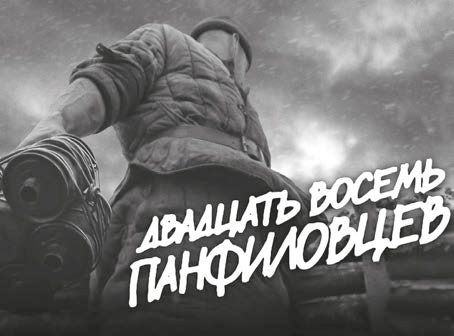
All later works about the Panfilov heroes included information from Krivitsky’s article. These include articles by N. Tikhonov, V. Stavskyj, A. Bek, M. Kuznetsov, V. Lypko and M. Svetlov. After being questioned by investigators, Kaprov, the former regimental commander, said that “there was no battle of the 28 Panfilov men with German tanks at the Dubosekovo junction on 16 November 1941 – this is a continuous fiction. On that day, at the Dubosekovo junction a part of the 4th Company of the 2nd Battalion fought against the German tanks and they did indeed fight heroically. More than a hundred men of the company were killed, not 28 as it was written in the newspapers. None of the reporters asked me then. I never told anyone about the 28 Panfilov men and I could not even speak on it because there was no such battle. I never wrote any political report about this event. I do not know on what materials the articles written on the battle of the 28 guardsmen of the Panfilov Division are based on, including those in Krasnaia Zvezda.”
However, the military prosecutor’s office, having followed their evidence, concluded in their report “…that the feat of the 28 guards-Panfilov men, illuminated by the press, is a fictional story created by the Krasnaia Zvezda correspondent Koroteev, the editor Ortenberg and, especially, the literary secretary of the newspaper, Krivitsky.”







