Myth
23
Ukrainians – Collaboration Champions of the World
Maksym Maiorov
Andriy Medvedev, New Ukrainian Heroes under the SS Banner, vesti.ru, October 2014.
“Collaborators were everywhere – among the Greeks and the British, among the Russians and Jews – but nowhere in the mass consciousness of the people was cooperation with the occupiers this encouraged. What is happening today in Ukraine and the Baltics is a European abnormality.”
■ The Essence of the Myth
Ukrainians were the main collaborators with the Nazis and were happy to work for them.
■ Fast Facts
The scale of Russian military collaboration with the Germans was bigger than the Ukrainian.
■ Detailed Facts
The collaboration of the Third Reich’s occupied peoples with the Nazi regime had a pan-European character. Its basis was political motivations and social causes – the need to survive in extreme conditions of warfare and a totalitarian regime. Economic and domestic cooperation could not be avoided in any of the occupied territories.
For the representatives of the European nations occupied by Germany, political and military cooperation with the enemy was a choice which jeopardized their civic duty towards their own homeland. An alternative to political and military collaboration could be active or passive resistance or simply the rejection of excessive assistance to the invader. Hitler’s captive western European nations could hope to win as part of the anti-Hitler coalition in order to solve the problem of their liberation.
The situation in Eastern Europe was different. Here, the Nazi occupational regime was tougher but the pre-war situation was also not acceptable to every resident. The problem of stateless people and hostile political regimes existed before the German occupation. This was especially clear in the territories that the Third Reich captured from the Soviet Union. The Nazis actively used the national questions in the USSR and people’s dissatisfaction with Stalinism in their fight against Moscow. However, instead of liberating the people as they had expected, the Nazis launched a regime of terror and even greater enslavement.
The nature and extent of cooperation was determined by the occupiers themselves and not their enslaved people. For political and ideological reasons, the Nazis chose which initiatives to support or encourage and which to suppress depending on the occupied population and German political thought. For example, in small Latvia, local residents formed two divisions of the Waffen-SS, but all petitions from the Polish political representatives about the formation of an allied Wehrmacht national force were rejected.
Small, stateless nations who were completely occupied by the Germans (like the Crimean Tatars) were in a particularly difficult situation. Logic dictating that national survival via cooperation with the invaders was paramount.
Consider the reasons for collaboration with the Nazis in Ukraine and Russia.
Both countries suffered from the totalitarian Stalinist regime and had reason to hope for the overthrow of Soviet authorities. Unlike the Russians, there was an additional motive for the desire of the defeat of the USSR in Ukraine – the desire to restore independence. This was especially true in western Ukraine, that was occupied by the Soviet Union for less than two years before the German occupation and this short experience was not very rosy.
Germany fully occupied the Ukrainian SSR, while the Russian Soviet Federative Socialist Republic (RSFSR) lost only about 17 percent of its territory. The entire population of Ukraine was larger than the population in the occupied territory of Russia. When the Wehrmacht reached Russian territory, Soviet citizens’ illusions about the “German liberators” had already been significantly weakened. The occupation of Ukraine lasted longer than that of the western regions of Russia.
Calculating the exact number of representatives of each of the two occupied nations who served with the Germans is not difficult. Although there was a clear correlation between the Nazis and the national military formations they created, there is no clear correlation between the national status of certain eastern battalions and the nationality of its personnel. In the “Russian” formations there happened to be many ethnic Ukrainians and vice versa. Even the political orientation of a soldier did not always determine his place in military service.
In general, researchers believe that there was about 250,000 “Ukrainian” personnel in formations of the Wehrmacht, SS, police and other structures. In “Russian” formations, this range falls somewhere between 300 and 800 thousand, depending on the methodology of calculations.
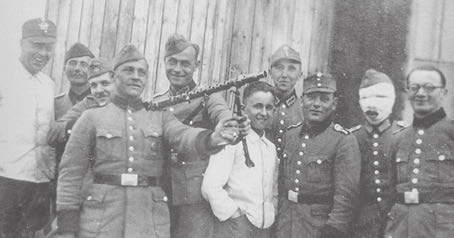
Most of the “eastern” units had company and battalion staff and belonged to the police or Wehrmacht (units of 100–500 people). Some of them wore the “ROA” (“Russian Liberation Army”) armbands while others wore the “UVV” (“Ukrainian Liberation Army”). There was only the 14th Waffen-SS Division “Galicia”, which formed in 1943–1944, among the Ukrainian forces in German service and numbered no more than 1000 personnel (during its entire lifetime, about 32,000 people went through its formation). By November 1944, the Division was officially denied the right to be called “Ukrainian.” Other large Ukrainian formations – regiments and brigades – only started to be created in the last year of the war.
Ukrainian soldiers of the 204th “Schuma” Battalion
From the very beginning there were more colorful and numerical units of Russian forces. The Russian Liberation People’s Army (RONA) which at first emerged as an antipartisan militia, turned itself into a brigade and later into the 29th Waffen-SS Division. In September 1943, RONA had 12–15,000 soldiers. The Russian Corps in the Balkans had over 10,000 soldiers. The Russian People’s National Army (RPNA) – 4,000 soldiers. The 1st Russian National Brigade of the SS “Fellowship” – 2,500 soldiers. The pro-Russian XV SS Cossack Cavalry Corps consisted of about 30,000 soldiers. The vast majority of prisoners of war who were colonels and generals of the Red Army did not serve in the “Ukrainian” but rather the “Russian” German formations.
In trying to find a political basis for Russian cooperation with the occupiers, they created “parties” which mimicked the Nazi party’s ideology. These were, for example, the Russian National Labour Party, the Fighting Union of the Russian Nationalists and the People’s Socialist “Viking” Party of Russia. The majority of Ukrainian political personnel who collaborated with the Third Reich were more politically mature and less exposed to Nazi indoctrination. Of course, there were cases of Ukrainian organizations who followed Nazi ideology, like the Ukrainian Free Cossacks, but their influence was negligible.
A unique phenomenon in the occupational zones was the Russian military-civilian governments. After receiving permission from Wehrmacht command, the “Lokot Autonomy” existed in the Bryansk province. Its Russian administration led a population of over half a million people for over a year. It was in these forms that the Russian anticommunist nationalist movement existed. The Ukrainians in turn established the UPA, which fought against both totalitarian regimes.
The military-political leadership of the Third Reich was generally more inclined to use the Russian national question rather than the Ukrainian. This was particularly evident in the closing stages of the war, when a desperate Berlin gave carte blanche on the active formation of national military units and their political representations. The Germans supported the Russians and inclined the Ukrainians to submit to their “big brother.”
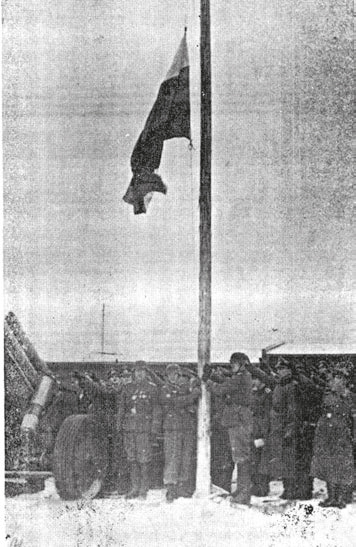
On 14 November 1944, the Committee for the Liberation of the Peoples of Russia (KONR) was created in Prague and led by General Andrei Vlasov. On 28 January 1945, soldiers began swearing their allegiance to KONR. In late April, they nominally were composed of three divisions (one was being formed) and with additional units, there were 120–130,000 people. Instead, the Ukrainian National Committee (UNC), led by General Pavlo Shandruk was only recognized by the Germans on 12 March 1945. Under the banner of the Ukrainian National Army (UNA), Shandruk managed to collect about 38,000 people, including two incomplete divisions.
In this way, Russian “success” in cooperating with the Third Reich seems more reputable and the Ukrainians should give up their place to them.
Soldiers of the 1st Division of the Committee for the Liberation of the Peoples of Russia (KONR) Armed Forces raising the Russian flag