Myth
24
The Nachtigall and Roland Battalion and the Galicia Division Were Punitive Units of the SS
Olesia Isaiuk, Sergii Riabenko
The Communist Party of Ukraine, Headline from Their Official Website, 7 December 2007
“Israel is ready to provide documentary evidence of the atrocities of the Nachtigall SS battalion under the command of Shukhevych.”
■ The Essence of the Myth
During the Second World War, the Germans created the Nachtigall and Roland battalions and the Galicia Division out of Ukrainian nationalists. These units were staffed with Nazi collaborators, including those from SS structures, its leadership was subordinate to the SS and used in their ranks. The Nachtigall, Roland and the Galicia Division were designed to kill civilians in the occupied territories.
■ Fast Facts
Nachtigall and Roland operated as part of the Wehrmacht and were never part of the SS structure nor did their soldiers ever receive SS ranks. At the beginning of the German- Soviet war, both battalions performed supporting functions and in the fall of 1941 were reorganized into the 201st Battalion of the Protective Auxiliary Police.
The Galicia Division was founded in 1943 but did not belong to the general SS but rather to the Waffen-SS (Armed SS) and was primarily used as a battle unit.
The Nuremberg Tribunal never declared the Galicia Division to be criminal as far as the Waffen-SS or the SS structures in general.
■ Detailed Facts
This myth was formed during Soviet times. According to the myth, all members of the Ukrainian resistance movement during the war were traitors and puppets in the service of Germany who gladly carried out all of their “owner’s” whims. The Germans entrusted them with their dirtiest job – conducting punitive actions against unarmed civilians.
In most cases, the authors of these “sensational” stories did not understand the differences between the military formations who operated on the territory of Ukraine during the war. Therefore, for the ordinary spectator, there are never any questions when one hears “SS Nachtigall Battalion”. But the facts show otherwise.
The Nachtigall and Roland Battalions were never part of the SS. The initiator of this was not the Reichsfuhrer-SS Himmler but the OUN, together with Wehrmacht officers and in particular with the German military intelligence (the Abwehr).
However, each of the founders of the battalions pursued their own objectives. To a certain extent, the OUN saw these two battalions as a basis for a future Ukrainian army. Indeed, in early 1941, the OUN leadership knew about the preparations of Germany for war against the USSR and hoped that at the moment of the beginning of the war, it would manage to organize an uprising in Ukraine and create an independent state.
To prepare for the uprising and the subsequent maintenance of the territory, people needed military experience and weapons. However, in the situation the OUN found themselves after the annexation of western Ukraine to the Soviet Union, its members could receive military training in the ranks of only one army – the German. Western European countries were not ready to accept the OUN as an independent player and would not give them any help. And talks with their main enemy – the USSR, were also unacceptable.
In talks with the leadership of the Abwehr, the OUN leadership tried to create special units where members of the organization were to undergo military training and afterward – to become the basis for the formation of a new Ukrainian army.
The German side had somewhat different plans. The Abwehr leadership regarded Nachtigall and Roland as reconnaissance-diversion battalions who, during the war, had to organize sabotage operations against Soviet military units, but also to ensure the safety of the moving German units, disarm remnants of the Red Army and protect the prisoner and ammunition wagons.
The tasks that the battalions were assigned by their Abwehr leadership, as well as the OUN, were significantly different from the tasks performed by the SS in the occupied territories.
The rank and file of the commanders of the battalion were Ukrainians. They wore military, instead of SS ranks and their commanders from the German side were also from the Wehrmacht. Nachtigall and Roland did not obey SS commands.
Despite OUN expectations, the two battalions were only used in a limited way during the fighting. In the summer of 1941, Roland moved into Moldova and the Odesa region, where its personnel stayed for a few weeks in anticipation of further orders and were then returned to Austria.
Soldiers of the Nachtigall Battalion
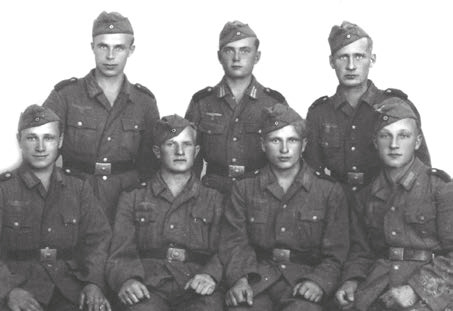
The Nachtigall battalion took part in the German army’s occupation of Lviv and reached Vinnytsia. Already in August 1941, it was withdrawn from the front and on 16 September, the two battalions were reformed.
The Galicia Division had a completely different history. Its creation began almost two years after the creation of the Nachtigall and Roland battalions in the spring of 1943, in eastern Galicia, which was then a part of the German General Government.
Although the official name of the formation had the abbreviation “SS” until April 1945, it was a purely military formation even from its very beginning. Therefore, it was not included in the general SS structure (Allgemeine SS), but rather in the so-called Armed SS (Waffen-SS). Over forty of such divisions existed and half of them were personnel from the German occupied and allied countries (Croatians, Latvians, Estonians, Hungarians, French, etc.). The Galicia Division was designed to fight on the front next to the Wehrmacht.
Poruchik (Senior Lieutenant) of the Galicia Division, Volodymyr Kozak. Note the collar patches: instead of the SS runes, the Galicia Division wore the “lion” – a stylized emblem of Galicia
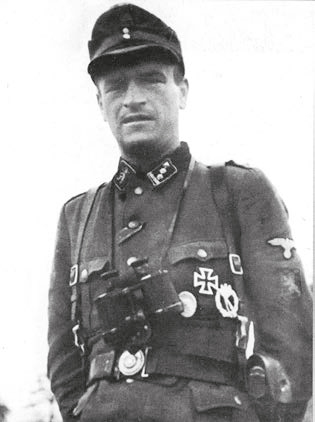
The rank and file and lowest command personnel were Ukrainians – mostly natives of Galicia. The Germans held command positions until 1945, although there were also some Ukrainians there, such as Mykola Palienko, one of the commanders of the battalions.
Ukrainians entered the ranks of the division with different motives. Some looked to the Galicia Division for the opportunity to gain military experience and weapons in order to join the UPA, which at that time was unable to train and equip large numbers of soldiers. Others hoped that the division would be the basis for the formation of Ukrainian military units that would fight the Soviet Union, even on the side of the Germans. There were also those who joined the ranks of the division to avoid the forced labour in Germany or to not remain on territory that would quickly be overrun by Soviet troops. A certain portion of soldiers were forcibly mobilized into the Galicia division.
Officially, the OUN-Bandera (OUN(B)) branch opposed the formation of the division and even appealed to the Ukrainians not to join. But in fact, a certain number of its members were in its composition. Their aim was also to receive training and weapons, and serve as a constant link between division soldiers and the UPA until it was the right time to organize their transition to the Ukrainian underground. In contrast, the OUN-Melnyk (OUN-M) branch urged young people to join the division, considering it an opportunity for the formation of an armed struggle against the USSR.
The Galicia Division took part in battles against the Red Army. In the summer of 1944, the division moved near the town of Brody in the Lviv region and was at the disposal of the 13th Army Corps, as part of the Army Group North Ukraine, where it was placed as a second line of defense. During the battle, the division was surrounded and defeated. Out of 11 thousand soldiers, only 3 thousand were in the vicinity, and 1,500 led by General Freitag retreated towards the Carpathian Mountains. The rest either died, were captured by the Soviets or joined the UPA. The division lost 70 percent of its personnel.
After this, the division was sent to Slovakia where it participated in the fight against the Slovak partisans. In January 1945, it was moved to Yugoslavia to fight against the communist guerrillas led by Josip Tito.
The Soviet myth about the division also included the allegation that the Galicia Division was involved in the suppression of the Warsaw Uprising in August-September 1944, but this was not true (more on that in Myth 41).
In April 1945, the division fought along the front near the Gleichenberg Castle in Austria. In late April, its troops were withdrawn from the Armed SS and given a new name – the “1st Ukrainian Division of the Ukrainian National Army.”
After Germany’s surrender, the division’s soldiers were interned in the British and American zones of occupation but after 1948, they immigrated throughout the world – to the USA, Canada, Australia, Argentina and other countries. In 1985, the Deschenes Commission was set up in Canada to investigate the possible presence of war criminals in Canada, including immigrants from Ukraine and the Baltic States. After studying archival materials and examining witnesses in Canada and Western Europe, the Commission prepared a report in which none of the emigrants who were former members of the Galicia Division were found guilty of war crimes during the Second World War.
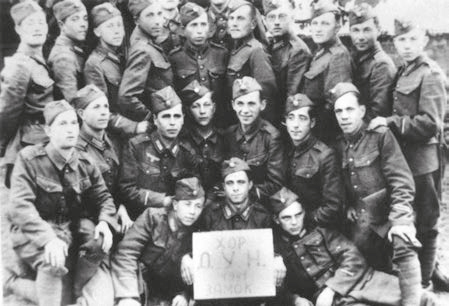
“Roland”
Battalion Choir
(1941)