
Myth
26
Roman Shukhevych Served in the Armed SS
Olesia Isaiuk
Anatoli Chaikovskyi, Bandera and Shukhevych were Agents of Hitler’s Secret Service and That’s It, Bulvar Gordona, 12 January 2010.
“Volunteers dressed in SS uniforms, their commander was claimed as a ‘Roland member’, Major Pobigischiy, and one of the captains – Shukhevych, who was promoted to the rank of SS Hauptsturmfuhrer and was awarded the Iron Cross.”
■ The Essence of the Myth
The Chief Commander of the UPA, Roman Shukhevych, had the rank of SS Hauptsturmfuhrer and received the German Iron Cross from Hitler, not once but twice, for participating in punitive operations against civilians.
■ Fast Facts
There are no connections between Roman Shukhevych and the SS, there is also no information that Shukhevych was awarded any insignia by the Wehrmacht or the Third Reich.
■ Detailed Facts
Long before the beginning of the global armed conflict, the Ukrainian nationalists considered the possibility of a new major war as a chance for an armed struggle for the independence of Ukraine.
The Ukrainians needed allies in the creation of a national military structure. However, the range of allies was very limited since the activities of these military formations was directed against countries that split up the Ukrainian people during the interwar period.
The OUN was aware that independence was only possible with the help of an army. An army needed not only brave rank and file but also professional officers and modern weapons. All of this could be provided by a state mechanism. And therefore, they needed to find an ally that would agree to help in equipping the core of this future army. Germany was considered quite a suitable option because of their common enemy – the Soviet Union.
The Nachtigall and Roland battalions were the result of an OUN agreement with the German military intelligence (the Abwehr) and considered by the Ukrainian nationalists as the nucleus for a future independent armed forces. They had no relations with the structures of the SS and acted within operational control of the Wehrmacht.
The OUN(B) fully understood they had an agreement with a totalitarian state that would pursue only its own interests. In order not to become an instrument for the wrong hands, the OUN(B) leaders put forward their own conditions – any future battalions would be under their political leadership and would be subordinate only to Germany in matters of military tactics and training. Ukrainian soldiers never took an oath to Germany. Also, the OUN(B) reserved the right to grant military ranks and introduced their own internal organization among the units. Both battalions were preparing for a war on the Eastern Front and could not, in any case, be used against the Western Allies. The OUN succeeded in granting the Ukrainian Nationalist Fellowship (DUN) – as the OUN called both battalions – the right to have their own chaplains, who became the spiritual guardians of the Ukrainian soldiers. Also, there was no Nazi propaganda among the DUN.
Roman Shukhevych in a “Nachtigall” Battalion uniform. There are no “SS” insignia – runes and skulls – on the uniform
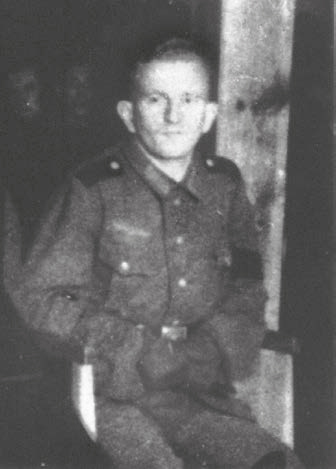
Roland and Nachtigall in the spring of 1941 were trained in Neuhammer and Seibersdorf (Germany). On 22 June 1941 – in the first hours of the Soviet-German war – Nachtigall took part in the fighting. The commander of Roland on the Ukrainian side was Major Yevhen Pobigischiy and the commander of Nachtigall was Captain Roman Shukhevych.
On 30 June 1941, Nachtigall arrived in German occupied Lviv. Here, all the soldiers received leave for a week while their commander had to take care of urgent personal matters. At the same time, a group of OUN(B) members led by Yaroslav Stetsko entered Lviv and they proclaimed the restoration of the Ukrainian state. This event took place on the same evening of 30 June 1941.
In August 1941, the soldiers learned of the arrest of the Stetsko government (Ukrainian National Government) in which Roman Shukhevych was appointed deputy minister of defense. The Nachtigall battalion soldiers demanded the release of the Ukrainian government officials. On 13 August, the “rebellious” battalions were withdrawn by the Germans from the front and sent to the rear, back to Neuhammer.
From Neuhammer, there was a written memorandum sent out demanding the release of the arrested OUN(B) Leadership and members of the government and the return of the battalion to the eastern front. These requirements were not fulfilled and the battalions were disbanded by the Germans.
Both battalions were reorganized in the autumn of 1941 into one group – the 201st Schutzmannschaft battalion, which was formed on a contract basis. After additional training, this battalion was sent to Belarus in order to protect communication lines. The local German occupational authorities in Belarus tried to persuade Shukhevych to participate in the recovery of “contingents” from peasants but received a strong negative as an answer.
On 1 December 1942, the term of the contract expired and the battalion soldiers refused to swear allegiance to Adolf Hitler. The battalion was moved to Lviv where the officers were arrested. Roman Shukhevych managed to escape and by November 1943 he led the UPA.
As we can see, Roman Shukhevych did not serve in any part of the SS. The Nachtigall battalion was subordinate to Wehrmacht command. During the Nuremburg trials, the question of the Nachtigall battalion’s participation in war crimes was never raised.
The story that Shukhevych allegedly received the Iron Cross from Hitler himself is also fiction. It was expanded on in 2007, by the leader of the Ukrainian Communist Party, Petro Symonenko, during a session of the Ukrainian Parliament. In actuality, there are Ukrainian on the list of Iron Cross recipients (mainly from the SS Galicia division) but Roman Shukhevych is not among them. In 2010, a court ordered Symonenko: “At the earliest moment, the judgement of the plenary session of the Verkhovna Rada of Ukraine is to come into force, to refute widespread false information about Roman Shukhevych.” Despite this, the myth of Shukhevych’s Iron Cross is still actively exploited in certain environments.
Indeed, Shukhevych did receive a medal, not from Hitler but rather from an underground government – the Ukrainian Supreme Liberation Council. Of course, this was not a German but a Ukrainian award: the Golden Cross of Combat Merit 1st Class and the Golden Cross of Merit 1st Class, which was awarded to the UPA commander in 1950, posthumously.







