Myth
29
The Only “Real” Partisans Were the Soviet Partisans
Igor Bigun
Sergey Buntovskyj, Bandera was not Alone…In Memory of the Real Heroes of Ukraine, antifashist.com
“Considering, that the personnel of the guerrilla groups which operated in Ukraine were recruited from local volunteers, then we can say that Ukrainians, with the exception of the natives in Galicia and Volhynia, were very active in the fight against the invaders. Some of those, who went to serve the Nazis, were not greater than people from other Soviet republics. This proves the fact that by 1941, the Soviet government was perceived by the populations of the USSR (except in the 1939 annexed lands) as their own. Accordingly, the pro-German nationalist organizations such as the OUN and UPA were mostly alien to Ukrainians.”
■ The Essence of the Myth
The Soviet partisans are “ours”, because they obeyed Soviet command and acted in the interests of the people. All other formations did not act in the best interest of the Ukrainian people.
■ Fast Facts
Soviet propaganda and historiography often saw history as a black and white picture. Everyone who was not “ours” were “fascists”. The activities of the other partisan formations were not noticed, ignored and quite often demonized, with information about them falsified. However, in Ukraine, various anti-German resistance movements were active including communist and nationalist ones. The same situation occurred in many other European countries.
■ Detailed Facts
During the Second World War, the European resistance movements were not able to achieve internal unity and create a single centrally coordinated leadership.
Often, in the occupied territories of Central and Eastern Europe, two or more resistance movements were formed. The nationalist variant fought for the creation of independent states or the restoration of their pre-war forms. Nationalist partisans subordinated themselves to the legitimate government of their countries, which were usually abroad. Their competitors were often partisans organized by the Communist Party. The communists, who sought to come to power in their own countries were generously supported by the USSR.
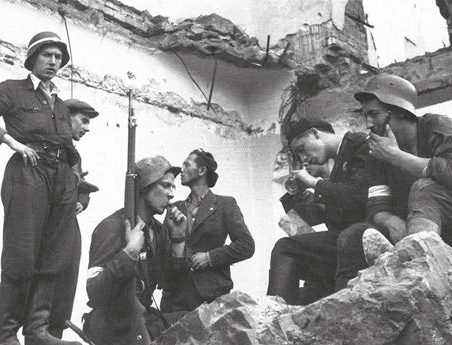
These great intricacies of the partisan movement were seen in Ukraine’s neighbor, Poland. After the German occupation, the soldiers of the Polish Army formed an underground-partisan movement known as the Home Army (AK). They performed the Polish government’s tasks, which operated in exile in London. This anti-Nazi and anti-communist force advocated for the liberation of Poland without the help of the USSR. However, the Polish Worker’s Party had its own forces, the People’s Army (AL). Its purpose was to establish a communist regime after the expulsion of the Germans.
Incidentally, this is not a complete list of Polish partisans. There was also the moderate-left’s People’s Party led the Bataliony Chlopskie (Peasants’ Battalion, BC). In numbers alone, this group (with 160,000 men) was only second to the AK (350,000) in partisan formations in Poland. As a result of the merger of 17 partisan organizations, the Polish National Armed Forces (NSZ) was created. These formations were recognized by the Polish government in exile in London, but had different views on the war’s strategy and tactics.
They were combined into temporary alliances but then competed among themselves. At times, it became a bloody mutual struggle. Especially uncompromising were the nationalist formations who wanted the communist AL out of the NSZ. After the war, the nationalist formations continued their struggle in Poland against the communist regime and became known as the “cursed soldiers.”
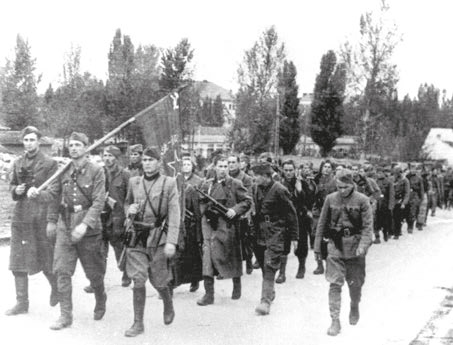
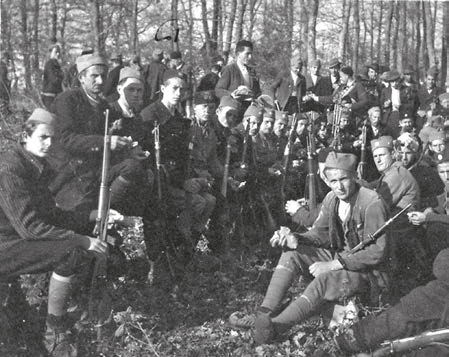
A real civil war unfolded in the Yugoslavian underground. The King’s faithful Chetniks fought not for life but rather for the death of the communist partisans. The Chetniks were former soldiers of the Royal Army, organized by General Dragoljub Mihailovic into the Yugoslav Army in the Homeland. Other partisan units were united in the National Liberation Army of Yugoslavia under the leadership of the Communist Party leader, Josip Broz Tito. The Western Allies initially supported the Chetniks but toward the end of the war, Tito’s partisans were favored. This was a decisive factor in their power struggle. In 1946, the Chetniks were defeated and Mihailovic executed.
Bloody infighting was also marked in the Greek resistance movements. The Communist Party formed the National Liberation Front’s military wing, the Greek People’s Liberation Army. Their greatest rival became the National Republican Greek League. A third partisan group was the National and Social Liberation, which fought for a liberalrepublican system.
Home Army partisans during the Warsaw Uprising (August- October 1944)
Under British mediation, all of these signed the National Bands Agreement in July 1943 for a joint struggle against the German-Italian occupation. But the communists did not want to restore the old order after the victory of the liberals. Therefore, in October 1943, the Greek People’s Liberation Army launched partisan attacks against other partisan groups. As a consequence, a bloody civil war began that lasted until 1949.
The resistance movement against the Japanese invaders in China, which lasted from 1937–1945, was also not simple. In order to expel the occupational forces, the nationalists under Chiang Kai-shek and the communists under Mao Zedong stopped their civil war and fought together. After the liberation of China, their mutual struggle was renewed.
The common struggle of the partisans of various political beliefs against an external aggressor was widespread. They all envisioned different futures for their countries after liberation. And they tried to eliminate their opponents from the arena of struggle. In this regard, Ukraine was not unique.
A Chetnik- Nationalist detachment before combat operations, Southern Serbia (1943)
From the first months of the German-Soviet war, the partisan struggle was organized by Soviet command. In 1942, the nationalist resistance movement began to be formed. The Polissian Sich was formed under the Otaman Taras Borovets and the OUN-M. At the turn of 1942 and 1943, the OUN(B) created the Ukrainian Insurgent Army. This diversity of nationalist partisans existed until the end of 1943, when the OUN(B) united them into a single UPA.
But the USSR tried to construct a black and white picture of the war, where there was a correct “us” and the traitors were the “Banderites.” In fact, across Europe, the communists and nationalists joined together for the destruction of Nazism and its satellite states, even though each was guided by its own strategy and goals.
Yugoslav communist partisans entering Belgrade (October 1944)