
Myth
30
UPA – “Hitler’s Henchmen” and Never Fought Against the Nazis
Igor Bigun
Dmytro Tabachnyk,
Minister of Education
and Science
(2010–2014), 12 November 2012
“There is no document which would testify to the UPA fighting against the Nazis. In ’42, and in ’43 and in ’44, the Germans supplied weapons to UPA detachments.”
■ The Essence of the Myth
The UPA was formed by the German invaders, and in close cooperation with them it conducted punitive operations against Soviet partisans, Ukrainians, Jews and Poles. There is no evidence of anti-Nazi battles of the UPA.
■ Fast Facts
The struggle between the UPA and the German occupiers and their allies are documented in numerous German, Soviet, Polish and UPA documents. The UPA, German and Soviet sides considered the UPA operations as an anti-German uprising.
■ Detailed Facts
The atrocious occupational policies of the Nazis forced the OUN(B) Leadership to defend the population with arms. The first UPA sotnia (company) was created on 22 January 1943. By February 7, it had defeated the German commandant’s office at the town of Volodymyrets in Rivne region.
In the spring of 1943, the UPA constantly increased their numbers and the scale of their resistance. The fiercest skirmishes against the Germans were in the Lutsk, Kovel, Horokhiv, Rivne, Kremenets, Kostopil, Sarny and Lanivtsi regions. In March 1943, the insurgents seized these regional centers five times. At the end of the first month of spring, the German government under Reichskommissar Erich Koch reported that only two regions were free of “gangs” in Volhynia.
The occupational administration began to carry out antipartisan operations involving armored vehicles and aircrafts. At the end of April, entire German divisions were transferred to the Berezne, Liudvypil, Mizoch, Ostroh, Shumsk and Kremenets regions to deal with the UPA.
The punitive actions of the Nazis were limited. If in March, the UPA units attacked German economic targets only eight times, then by April it increased to 57 attacks and in May – 70.
At a meeting in Rivne on 5 June 1943, the Minister for the Nazi Occupied Eastern Territories, Alfred Rosenberg and the Head of the Occupational Authorities in Volhynia and Podillia, Heinrich Schoene, reported that in his administration the “Ukrainian nationalists cause more difficulties than the Bolshevik gangs.”
Interestingly, this fact was later acknowledged by the leadership of the Soviet partisan movement. The commander of the Soviet partisans, Petro Vershigora, on 4 March 1944, reported to the Ukrainian Headquarters of the Partisan Movement: “We cannot allow the same mistakes in Poland that we had in Volhynia, giving the leadership of a popular uprising against the Germans into the hands of the counterrevolutionary, nationalist groups.”
The available Nazi forces to suppress the resistance were not sufficient. Therefore, in July 1943, the struggle against UPA forces was taken up by the anti-partisan commander in the East, Erich von dem Bach. The 8th SS Cavalry division Florian Geyer, consisting of 10,000 soldiers and 10 artillery battalions, were transferred under his direction. Air cover was given by 27 aircrafts, on the ground there were 50 tanks and armored vehicles.
However, the UPA maneuvered themselves accordingly and were not destroyed. Overall, in July, insurgents attacked German bases 295 times and agricultural targets, 119 times.
At the beginning of August 1943, von dem Bach withdrew to Galicia for the fight against the Sydir Kovpak’s Soviet partisan detachment raid. The German attacks lessened and so the anti-German activities of the UPA increased: 391 attacks on garrisons and 151 attacks on enterprises.
But soon, the Higher SS and Police Leader in Ukraine, Hans Prutzmann, organized new attacks against the UPA. These attacks occurred in southern Volhynia from 23 August to 9 September 1943. At first, the village of Antonivtsi was bombed, which was the headquarters of Bohun military group. Following this, the punitive expedition attacked UPA camps around the Kremenets forests. The Bohun military group was split into small units and broke out of the encirclement.
In the summer of 1943, the insurgent movement against the Nazis appeared in Galicia. On 18 August, the Ukrainian People’s Self-Defence (UNS, the original name of the UPA in Galicia) attacked a German stone quarry in Skole, Lviv province. The nationalists freed 150 forced laborers and the camp guards were destroyed.
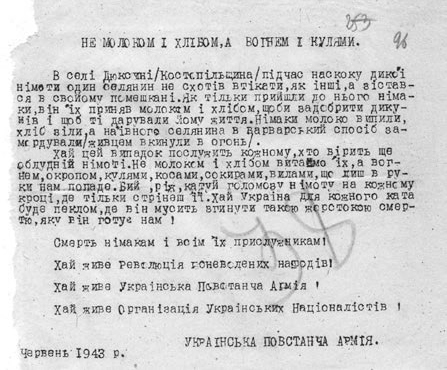
UPA leaflet calling for: “Death to the Germans and all their Henchmen! Let Live the Oppressed Nations! Let live the Ukrainian Insurgent Army! Let Live the Organization of Ukrainian Nationalists!” (June 1943)
In autumn 1943, the large-scale fight between the insurgents and the Nazis began. On 3 September, near the town of Dolyna, the Ukrainian soldiers shot the German battalion from higher ground in order to draw them into the narrow mountains. The occupiers left about 200 soldiers on the battlefield. From 25–29 September, the Trembita Sotnia deflected a punitive attack on their camp on Mount Stovba.
From 29–30 November 1943, there was a large battle between 1,500 and 2,000 Schutzmann and the Kryvonis-II battalion near the village of Nedilna in the Sambir region. The insurgents retreated with considerable losses but left the battlefield with almost their entire battalion headquarters and the battalion in tact.
In Volhynia, the last big anti-insurgent operation was directed by Prutzmann in November 1943. Between 2–3 November, the city of Stepan was bombed from the air and the Zahrava military unit was pushed northward. Simultaneously, on 3 November, German planes bombed and shelled the town of Kolky, where the UPA formed the Kolky Republic (more on this in Myth 31). It should be noted here that the Nazis were not able to capture the territory of the so-called Republic from June until the beginning of November 1943, when during the attack, 600 civilians were killed.
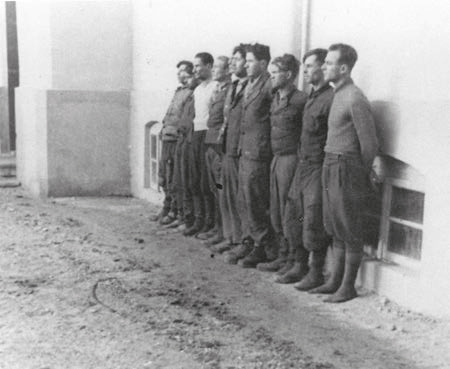
Nazis shooting insurgents taken prisoner during the Battle of Nedil’na, Drohobych (2 December 1943)
In October-November 1943, there were 47 battles between the UPA-UPS and the German occupiers, and rural UPA self-defense units were involved in 125 battles. The Germans lost more than 1,500 soldiers.
The complete suppression of Nazi activities by UPA resistance failed. With the fast approaching Soviet-German front, most German military forces were transferred. Therefore, massive German anti-partisan operations in Volhynia were no longer necessary.
In Galicia, this confrontation lasted until the end of the summer in 1944. The UPS reformed itself into the UPAWest. UPA soldiers in March-April 1944 defended Ukrainian villages from German looting. Sometimes, it was not fully successful. In May, the Wehrmacht broke the Halajda and Siromantsi Sotnias in the Lviv province.
From 31 May to 6 June 1944, in the Chornyj (Black) Forest, the UPA fought the 7th Armored Division of the Wehrmacht. The confrontation reached its peak in Galicia in mid-summer.
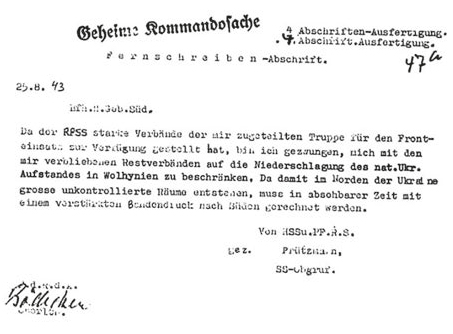
Telegram of Hans Prutzmann concerning the suppression of the “Ukrainian Nationalist Uprising” in Volhynia (25 August 1943)
The biggest clash of the UPA-West and the German-Hungarian troops took place around the Lopata Mountains at the junction between the Drohobych and Stanyslaviv (Ivano-Frankivsk) regions. These events are also reported on in great detail in the written reports of the Polish underground. From 6 to 16 July 1944, there was intense fighting from artillery shelling which moved through the melee of battles. But the insurgents were victorious under the command of Vasyl Andrusiak, “Rizun”. The occupants lost about 200 soldiers and retreated, while only 50 Ukrainians were killed.
Under the blows of the Red Army, the Wehrmacht left Ukraine. By early September, there were mostly only minor clashes and disarmament of German units by the UPA.
There were episodes in the history of the Ukrainian insurgent movement when some commanders tried to hold illegal talks with German command where they offered “neutrality in exchange for weapons” or “food in exchange for weapons.” We also know of several cases when based on these talks, around 80–100 small arms were handed over to the insurgents. But such arrangements were not welcomed by the command of the Ukrainian underground. In some cases, they were even punished. In March 1944, Porfyrij Antoniuk (“Sosenko”) was shot for these illegal negotiations based on a sentence given by an UPA court-martial. Also in April 1944, the UPA executed Mykola Oliynyk (“Orel”).
Afterward, talks with the German occupational authorities were held with the OUN(B) leadership. The occupiers were interested in stopping OUN and UPA anti-German activities in order to throw more of their forces against the Soviet attack. The OUN sought to secure the release of political prisoners from concentration camps (Stepan Bandera, Yaroslav Stetsko and many others) and obtain weapons for the UPA, which they always lacked. The meetings between the OUN leadership and German authorities took place in March, April, June and July 1944. The result was that the insurgents received hundreds of weapons and in September-October 1944, the Nazis released Bandera and other Ukrainian nationalists, who, however, were left under Gestapo supervision.
In return, the OUN(B) reduced the intensity of their anti- German operations (mainly in Volhynia) but did not stop them altogether. As reported by German Major Muller, an officer in Army Group “South”, “at that time, as some national-Ukrainian bands put themselves upon the orders of the German Wehrmacht or performed their tasks, others made mad battles against the Wehrmacht with fanatical hatred.” Examples of such “mad battles” were in the Chornyj Forest or along the Lopata Mountains in Galicia which are mentioned earlier.
The activities of the UPA were recognized as anti-German by the insurgents and by the German occupational leaders like Schoene, von dem Bach and Prutzmann and the Soviet partisan commander, Vershigora. Researchers estimate the losses suffered by the Germans and their allies due to the UPA were about 12,000 soldiers. In the armed confrontation with the occupiers, the Ukrainian underground and insurgent units lost between 10–12,000 people.
In order to put an end to this myth of history, one must cite one of the many German documents that the former Education and Science Minister, Dmytro Tabachnyk, “did not know” about. This is the telegram from Prutzmann from 25 August 1943: “The General Command of the Army Group ‘South’. In relation to the fact that the SS Reichsfuhrer gave strong detachment units, they assigned me military units for the front, I have to limit the remnants of these units in order to suppress the Ukrainian national uprising in Volhynia. In northern Ukraine, large uncontrollable areas have arisen, that in the near future should expect an increase of pressure from these southern gangs.”







