
Myth
31
The UPA Did Not Derail a Single Train Wagon
Igor Bigun
Yuri Kozlov, The Banderitization of Ukraine
“The so-called UPA, during its entire existence, never destroyed any German tanks, did not derail any railway trains, did not liquidate any German general-punitive units. There is no document that claims that the UPA leadership made any decision on military actions against the German army.”
■ The Essence of the Myth
The UPA did not cause any losses to the German occupiers and did not play any role in the liberation of Ukraine from the Nazis.
■ Fast Facts
The number of German personnel killed by the UPA, was small compared to the number killed by the Soviet partisans in Ukraine. However, the Ukrainian insurgents tipped the anti-German struggle mainly by countering the economic despoils of the local population, exporting the Ostarbeiter for forced labor and defended Ukrainians from punitive operations.
■ Detailed Facts
How did the strategic goals of the UPA differ from the Soviet partisan movement?
Soviet partisans were organized by state groups who fought in the Wehrmacht’s rear for the benefit of the Red Army. The headquarters of the partisan movement, which was in Moscow and other unoccupied cities, supplied the partisans with command personnel, weapons, equipment, medicine and other resources, including cigarettes. The main purpose of the partisan struggle was to gain intelligence, sabotage German communications, destroy military equipment and carry out terror attacks on high-ranking officials of the occupational administration.
The UPA wanted an independent Ukrainian state. The OUN(B) wanted both the expulsion of the Germans and were against the return of Soviet power. Therefore, facilitating the victory of the Red Army was not part of the plans of UPA command.
The UPA did not receive any help from anyone and had to fight with whatever they could. The main anti-German nationalist struggle was in their opposition to the economic exploitation of Ukraine and the protection of local residents from terror and from being exported for forced labor.
The UPA’s priorities were to establish control over the countryside or to cut the Nazi state from its source of agricultural products. During the spring of 1943, the UPA was able to take control of most of the areas of the general Volhynia- Podillia region. The leader of the district, Heinrich Schoene, on 30 May, was forced to admit that “only the territory along the highways and railways are in the hands of the Germans.”
In the areas where the UPA expelled the occupiers, “insurgent republics” were created. In these republics, the UPA High Command organized the local administration, conducted elections, established schools, assigned land, and restored companies and so on.
The most famous was the Kolky Republic. On 13 June 1943, the UPA unit Kotlovyna won control over this district town in the Volhynia province and established their own Ukrainian authority. The insurgents reopened the power station, bakery, dairy, post office, school and a Ukrainian administration.
The people lived without an occupying force until 3 November, when the Nazis won Kolky with the help of paratroopers, aircraft and armored vehicles.
Famous Soviet partisan commander, Pyotr Vershygora, confessed: “…The west bank of the Horyn River, the Stydyn, Stepan, Dubrovytsia regions, the Kolky-Rafalivka region were in the hands of the UPA…The Volhynia – in particular the Horodyshche, Turiisk, Porytsk, Horokhiv and Volodymyr- Volynskyi regions were completely under the control of the UPA. Enemy garrisons were only in the large settlements along communication and regional centers…”
In Galicia, by the end of April 1944, the UPA controlled 40 villages (the Bibrka, Peremyshliany, Berezhany and Rohatyn regions). The capital of the “republic”, which lay on the side of the road among the forest, was the village Dusaniv.
In order to wreck the opportunities for the Nazis to rob Ukrainians, the insurgents attacked German companies, warehouses, Liegenschaft (state farms). On 25 June, the Reichskommissar Erich Koch recognized that the “insurgents and partisans attacked important access points in the country and the rails, roads and bridges supplying the front, state farms, dairies, grain and hay stocks and industries available to them.” The Polish underground of the Home Army reported in July that on the territory of the Volodymyr-Volynskyi region, the UPA burned 17 major German farms, and 24 in the Lutsk region.
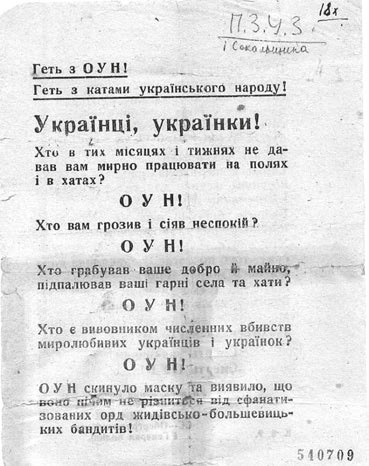
Leaflet against the OUN calling for: “OUN Out! The Executioners of the Ukrainian People Out!”, which was signed by the German General von dem Bach distributed in Volhynia in summer 1943
The real threat for the UPA were attacks led by the German landwirtschaftfuhrer, officials responsible for pumping food from the Ukrainian peasants. During the night of 19–20 March 1943, the sotnia of Ivan Klymyshyn (“Kruk”) killed a landwirtschaftfuhrer in his house in the city of Kremenets. On 20 June, another sotnia killed a landwirtschaftfuhrer during a fight with police in Berezhtsi. In July, the insurgents eliminated the landwirtschaftfuhrer from Verba and Demydivka regions of the Rivne province. On 2 October, the Velykan’s sotnia, under the command of Mykhailo Kondras (“Velykan”) during their raid on the village of Popivtsi in the Volochysk region, Khmelnytskyi province, killed the landwirtschaftfuhrer and two of his guards. By the end of the occupation, no landwirtschaftfuhrer in Volhynia could be assured of his life.
The UPA carried out constant attacks on the economic infrastructure of the Reichskommissariat Ukraine in Volhynia which led to the loss of the following by the end of April 1943:
– 74.82 percent of arable land for supplies;
– 76.45 percent grain standards;
– 77.86 percent of cattle supplies.
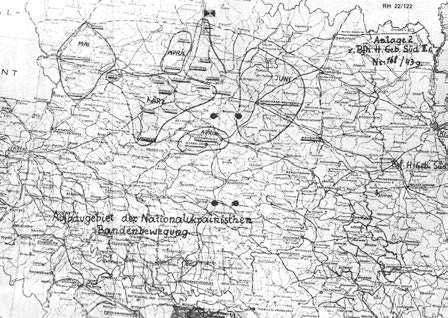
German map from 17 July 1943, showing regions of Volhynia where the UPA operated
The same Soviet partisan commander Vershygora confirmed that: “The economic situation of the regions which the UPA controls is more favorable than the Soviet areas, the population lives richer and there is less robbery…”
More successful was the UPA and OUN underground sabotage activities against the export of Ostarbeiter, forced laborers, to Germany. In 1942, from the wider Volhynia- Podillia area, 233,000 people were taken to Germany for forced labor, for the whole year of 1943 only 43,000 people were taken, thus over 5 times fewer.
UPA diversion on railways happened infrequently. Unlike the Soviet partisans, the insurgents did not have any aircrafts that could deliver explosives. Thus, the nationalist were limited to sabotaging railway lines of local importance.
In the spring of 1943, the local UPA troops destroyed the track in several places on the Sokal-Volodymyr-Volynskyj- Kovel railway. And until the arrival of the Soviet front in 1944, these connections were not used. On 7 June, the peasant troops damaged the Lviv-Lutsk rail line and derailed a German train between the villages of Brany and Stoyaniv. Thirty Germans were killed. The German administration admitted that in July 1943, the Ukrainian insurgents made 682 sabotage operations on railways and in August, 1034.
Anti-German UPA operations lasted for about a year and a half, from 1943 to mid-1944. It is necessary to remember that during this time, the Ukrainian insurgents killed about 12,000 German soldiers, their allies and servants. This was correlated with the real (and not twisted by the Soviets) losses of Germans as a result of Soviet partisan activities in Ukraine, up to 15,000 people.
The insurgents dealt sensitive blows to the German economy in the occupied territories, disrupting the export of Ostarbeiter from Volhynia and by clearing a significant number of the rural areas of the Nazi occupiers.







