Myth
36
The Crimean Tatars – “Traitor-Nation”
Sergii Gromenko
Ihor Pykhalov, Why Did Stalin Evict a Peoples, 2008
“As we see, being a part of the Russian state, the Crimean Tatars betrayed their country every time an enemy came upon Crimean land. Their expulsion was well deserved and an appropriate action. The guilt of the Crimean Tatars was so obvious that even Khrushchev, who rehabilitated ‘the innocent victims of illegal repression’ right and left, did not dare return them to their ‘homeland.’”
■ The Essence of the Myth
All Crimean Tatars during the Crimean occupation collaborated with the Nazis, fought against the partisans, slaughtered civilians and therefore were fairly and justified deported in 1944.
■ Fast Facts
Among the Crimean Tatars there were about 15–16 thousand collaborators, but almost all of them eventually died or were arrested by the NKVD. The punishment of an entire nation for the sins of some of its members is a crime against humanity that shows signs of genocide.
■ Detailed Facts
In a memorandum to Stalin on 10 May 1944, Beria stated two reasons for the deportation of the Crimean Tatars: “treason” against the Soviet people and the “undesirability” of these inhabitants along the border. The next day, the allegation of mass collaboration was repeated in the decision of the State Defense Committee No. 5859cc on the eviction of the Tatars.
However, in the occupied territories of the Soviet Union not a single nation exists that did not, to some extent, collaborate with the Nazis. If this applies to all people who came under German occupation, why were the Crimean Tatars such an exception?
About 15–20,000 Crimean Tatars went through the German “volunteer formations” (“Hiwi”) during the war. Incidentally, this number was never in the ranks of these units simultaneously. What is also often forgotten is that in the “Tatar” battalions, apart from the Crimean Tatars, were other nationalities. Between 15–16,000 were Tatar, which amounted to 6.5–7% of the entire Crimean Tatar population.
The fate of the collaborators is indeed greater than the average in the occupied areas of the USSR. But this is not enough to charge it with “total collaboration.”
These charges also do not take into account the specificity of “small nations” who completely fell under the occupation. Therefore, modern public moods should be taken into account for this game. The hope for small nations to escape on their own was useless. The Nazis also flirted with the national feelings of the indigenous Muslim peoples of the Soviet Union. In this context, it is worth mentioning that 180,000 so-called “Turkestan-men” served in the Wehrmacht, although the war did not spread to Central Asia.
Overall, the Crimean Tatars fought more in the Red Army ranks than in the various military and paramilitary formations associated with the Wehrmacht and the occupational authorities.
The maximum number of Crimean Tatars in the “Tatar” auxiliary detachments of the German armed forces at the end of 1943 amounted to 15–16,000.
The most efficient part, the 5–6,000 “Hiwis,” were evacuated from the Crimea along with the 11th Wehrmacht Army and fought outside the peninsula.
Out of the three thousand personnel of the Schuma battalion, a third were disarmed by the Germans and placed in concentration camps. Most likely, these thousand people still ended up in a GULAG after the war. Part of the “selfdefense” moved to the side of the partisans, including the whole of A. Rajimov’s company.
Close to 3,500 men from the German volunteer formations were evacuated to the west with the retreating Wehrmacht. In actuality, Beria’s informants believed that about 5,000 “active minions” were evacuated but the rest, mostly women and children, were shipped to Romania and Bulgaria via sea ports from 14 to 26 April 1944.
The fate of the Crimean Tatars developed differently. After 1944, 2,500 of those enlisted were reformed and re-located into East-Turkish units of the Battle Group “Crimea”. More than 800 “Hiwi” were sent to the 35th Grenadier Division. The remaining were enrolled in the Volga-Tatar Legion in France and supported anti-aircraft units. Therefore, all together about 8,5–9,000 male collaborators came from the Crimea. By the time of Germany’s surrender, only about 3,500 “volunteers” were still alive. The rest died or disappeared. At the end of the war, a very significant part of them were returned to the USSR, where they were sent to GULAGs.
In Crimea, about 5,500 Crimean-collaborators remained, of whom almost a thousand were killed in battles.
Immediately after the expulsion of the Nazis from Crimea, the Soviet state security services began hunting for “anti- Soviet elements”, mainly through paramilitary groups.
In accordance with Beria’s proposal from 5 July 1944, there were 7,833 arrested, carried out with more than 15,000 rifles and automatic rifles, more than 700 machine guns and 5 million ammunition. The fate of these people, of which almost 6,000 were Crimean Tatars was obvious – arrest, detention, camps.
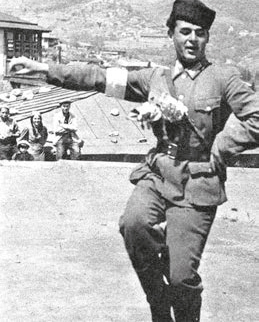
Crimean Tatar volunteers in the Wehrmacht dancing on the southern coast of Crimea (summer 1942)
Therefore, the majority of collaborators either perished in battle or suffered individual punishment after the war. Very few could escape punishment for collaborating with the enemy. In the Soviet regime and its modern apologists, there is no reason to justify the deportation of the Crimean Tatars due to their “mass collaboration” with the Germans. Anyone who was to be punished, should have been done so individually.
Entire families and those Crimeans who served honestly in the Red Army, as well as most of the Crimean Tatar soldiers and officers who could not return from the front to their fatherland, Crimea, were not spared relocation (a little more about this in Myth 35).
The concept of the “Tatar-traitor” is one of the key components of the general Russian myth about the “ancient Russian Crimea.” No charges against the Crimean Tatars of “mass treason” could justify deportation and without an excuse to this crime, one cannot explain the total Russification of the peninsula. All of this can only be attempted to be justified as one of Stalin’s many genocides.
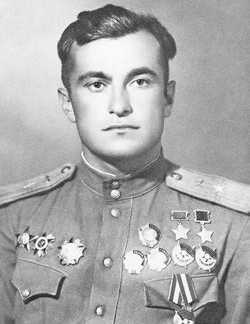
Pilot Amet-Khan Sultan, Crimean Tatar, twice awarded Hero of the Soviet Union (1945)