Myth
39
The Red Army – Which Liberated Ukraine from the Fascists – Was Shot in the Back by the UPA
Olesia Isaiuk
Vladislav Gulevich “The Dwarf’s Rabies”, August 2014
“Captured Ukrainian soldiers walked through the streets of Donetsk. Their grandfathers, great-grandfathers fought against fascism and these – were imitating the fascists themselves. And even in battle under the blue-yellow flag, the same one under which the OUN-UPA shot the Soviet soldiers in the back.”
■ The Essence of the Myth
The UPA fought against the Red Army which fought against the Third Reich and this is proof that the UPA acted on the side of the Nazis.
■ Fast Facts
The UPA fought against both the Soviet Union and the Third Reich, and saw the USSR as an aggressor and enemy of an independent Ukraine. But the Red Army was not the enemy of the UPA but rather the Communist Party, the NKVD and other repressive elements of the Soviet Union.
■ Detailed Facts
Between February-March 1944, the Red Army carried out operations on the territory of western Ukraine. At the same time, the Ukrainian Insurgent Army was also active in Volhynia and Galicia and was opposed to the Nazi troops. The Red Army also represented the totalitarian regime that was hostile to Ukrainian statehood but the attitude to her was radically different.
Before the entry of the Red Army into western Ukraine, on 24 December 1943, UPA command gave tactical instructions on the future offensive of the Red Army and how to behave in these changing circumstances. According to this document, UPA units were forbidden to engage in battles with the Red Army, even in order to acquire weapons, and were ordered to spread into villages and farms and “sit out” the front.
There were several reasons for this decision. First and foremost, the main objective and the main enemy of the fight of the anti-Soviet underground was the Communist Party and the NKVD. The Red Army was considered a possible field for nationalist propaganda, whose purpose was to bring its soldiers over to the insurgency.
The second was more pragmatic. In a military confrontation against the soldiers of the stronger Red Army, the UPA would only weaken itself and could not achieve any tangible results.
There were cases when the Ukrainian underground learning from intelligence reports about the ethnic composition of Red Army units, avoided clashes with “Ukrainian” Soviet troop units.
But, despite the good intentions of command, their instructions were not always followed. Western Ukraine was overrun to the point, that, avoidance of clashes was extremely difficult. In addition, many commanders acted based on the tactical situation of the “here and now”. Therefore, fights between the Red Army and the UPA occurred. According to various estimates, from January to March 1944, there were 153 to 200 of such attacks, in April-May 1944 their number reached 350. There were also full-scale battles, like, for example, on 22 March near Derman in Volhynia.
Ukrainian insurgent leaflet to Red Army soldiers calling on them to join the fight for an independent Ukraine (1944)
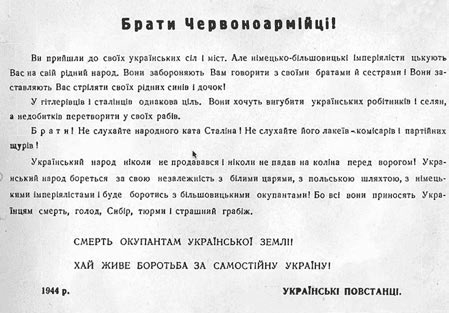
Further clashes were provoked by the punitive actions of NKVD which involved the Red Army – this occurred in late September-October 1944. This type of practice became more frequent in the spring of 1945, after the end of the war in Europe. At this point, the insurgents who were in the “not shooting those who are shooting at you” situation, were then forced to take up arms.
UPA command ceased to succeed in reminding their subordinates that they should not fight the Red Army but rather the NKVD troops. A separate UPA Supreme Command decree ordered their soldiers not to attack the Red Army first, unless the situation required opening fire. The attitude to the captives was regulated in individual instructions published on 5 August 1944, the second edition on 26 April 1946. The prisoners were supposed to be handled correctly, spoken to politely, avoid indiscretion, fed, provided recreation and – if necessary – their wounds treated. Other instructions for dealing with Red Army soldiers included banning any ridicule of the Soviet order.
Despite the extremely unfavourable conditions for realizing contact talks, there were many cases when meetings of insurgents and Red Army soldiers ended on quite friendly terms. In August 1945 near the village of Nevochyn, the Red Army soldiers told the insurgents where the KGB divisions were located and on their farewell, said “goodbye” and advised them to “beat those bastards.” A month before this event, the Red Army soldiers and insurgents peacefully “divided” among themselves the village of Pidpechery in Ivano-Frankivsk province. By chance, the Dzvony sotnia and a Red Army unit quartered there together. Relations were almost neighbourly, the insurgents generously endowed their neighbours with propaganda literature.
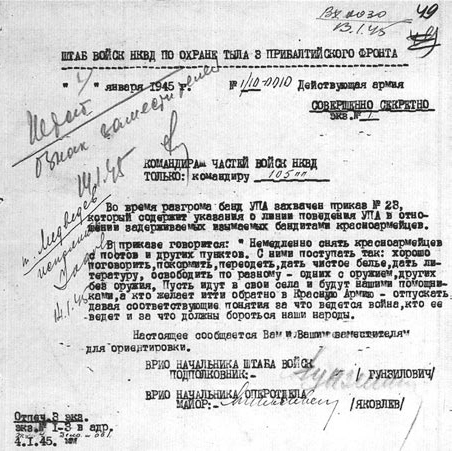
Red Army prisoners of war were often released by the insurgents after having propaganda conversations with them. In March 1944, insurgents released 10 people from captivity, who were also fed. And such cases are often mentioned in documents.
This should not be a surprise because the main enemy of the UPA was the NKVD troops. It was a struggle carried out systematically and did not stop.
And the biggest battles, like the battle of Hurby in April 1944 or the battle of Univ in September 1944, was carried out by the UPA against the NKVD.
The fight against the NKVD lasted long after 1945, the last battle of the Ukrainian Insurgent Army was recorded in the early 1960s.
Notification of the Command of Internal Troops of the NKVD that insurgents release captured Red Army soldiers (4 January 1945)