
Myth
40
Zhukov and Beria Ordered the Deportation of all Ukrainians to Siberia
Rostyslav Pyliavets
From “Order” No. 0078/42, 22 June 1944
“Send all Ukrainians, who lived under the German occupation, to the distant borders of the USSR.”
■ The Essence of the Myth
In June 1944, a joint order from Beria and Zhukov on the deportation to Siberia of all Ukrainians who were under German occupation was released. It was not realized because the eviction of so many people (over 20 million) in such a short amount of time was impossible.
■ Fast Facts
This document is a German propaganda leaflet.
This leaflet was Hitler’s propaganda attempt to undermine the combat and morale of the Red Army, and was largely aimed at Ukrainians.
■ Detailed Facts
The fact that the Soviet government planned the deportation of the Ukrainians who “lived under occupation” to “the distant borders of the USSR” in 1944 – is one of those myths about the war which appeared not during the USSR or in modern Russia but in Ukraine after its independence in 1992.
However, back in 1956 in Nikita Khrushchev’s, the USSR’s First Secretary, report “On the Personality Cult and its Consequences” at the XX Party Congress he spoke about the deportation of peoples under Stalin: “Ukrainians have escaped this fate because there were too many of them and there was nowhere to send them. If not for that, he would have evicted them.”
The documentary foundation to the myth, the faked Soviet order, was found in the Central State Archive of Public Organizations of Ukraine (f. 1, op. 70, str. 997, arc. 91) and published on 27 February 1992 in Literaturna Ukrajina newspaper by the candidate of historical sciences, Vasyl Marochkin.
But Marochkin did not include all the information about what he found in the archives. He did not say that this document claimed to be an order was only a German propaganda leaflet. Almost immediately, this “oversight” was identified. Literaturna Ukrajina published a letter to the editor on 5 March 1992 from Ruslan Pyroha, the then director of the archive where the document was found. But his explanation did not convince many people.
The first month after the publication of this order in Ukraine, its authenticity was repeatedly and reasonably decried. However, consciously or unconsciously, it was referred to in different publications.
Therefore, it is necessary to explain it in detail.
Decisions on deportations would usually be taken by the USSR’s State Defence Committee and arranged through a decree of the Presidium of the Supreme Soviet of the USSR, a decree of the Council of People’s Commissars of the USSR or through the USSR’s State Defence Committee. Or an order would refer to a resolution from the Defence Committee. In our “order”, this procedure was not followed.
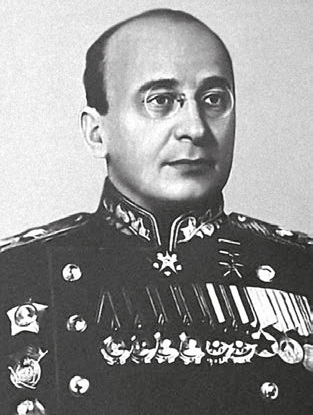
General Commissar of State Security, Lavrentiy Beria who in 1938–1945 led the NKVD of the USSR. Was personally responsible for organizing and carrying out mass deportations of people from the USSR during the Second World War)
The formation of the said faked order did not meet the requirements for forming these types of documents. The order was allegedly signed by two Commissariat leaders and the text reads in the singular – “I command” (should it not be “we command”?) Zhukov’s position is stated as Deputy Commissar of Defence whereas he was, in fact, the First Deputy Commissar of Defence.
Other nuances should be noted, including the fact that Soviet documents of NKVD divisional troops never used the word “punitive.” In the document, the 12th and 25th NKVD Divisions were mentioned. The 12th Infantry Division was not part of the NKVD and was stationed in the Far East. The 25th Division was part of the NKVD but it was used to protect railways.
Most importantly, according to rough estimates, there were at least 20 million people living on the territory of Ukraine during the German and Romanian occupation. Was it even possible to suddenly evict, as was stated in this “order,” that many people with only two divisions?
According to Beria’s report to Stalin from April to June 1944 the Crimean Tatars, Bulgarians, Greeks, Armenians and other foreign nationalities were deported from the Crimea to the eastern regions of the USSR, a total of more than 225,000 people. This operation involved 23,000 soldiers and officers of the NKVD troops with a ratio of ten deported to every one NKVD soldier.
Therefore, in order to evict “all Ukrainians”, it would have been necessary to involve at least 2 million NKVD troops.
In order to activate that many personnel and carry out the deportation of that many people in such a short amount of time and also “at night and suddenly, so as to prevent escape and so no family members warn their relatives in the Red Army,” was absolutely unrealistic.
The timing of the beginning of this operation (“eviction is to begin after the grain is harvested and given to the state for the needs of the Red Army”) is not very specific and means that the order is unacceptable because the function of an order is to coordinate and synchronize the actions of many people.
Among the main arguments of those who believe in the validity of the order is the testimony of the former head of the Ukrainian SSR NKVD, General Vasyl Riasnoj, a Russian poet, writer and journalist. His convictions and political views are those of an ardent supporter of Stalinism and were written in Felix Chuev’s book Soldaty Imperii: Besidy. Spohady. Dokumenty. However, the testimony that Chuev translated is not credible, as is shown by the modifications in the text of a published work by Morachkin.
If one were to believe Chuev, than Riasnoj, after realizing he held the order to evict all Ukrainians, pointed out that “this order was brought to me from Moscow by one of the deputy Commissars of Internal Affairs.” Who exactly brought it, Riasnoj failed to mention. But the most important issue is that “for the active work against the Red Army with the OUN, the performances of the ‘boiivok’ (OUN security agents), for the hostility to the Russian people, comrade Stalin ordered to evict all Ukrainians from their motherland and specifically – to Siberia.” The order was issued “on behalf of” Stalin (since the order was signed by Beria and Zhukov, Riasnoj does not mention any of this).
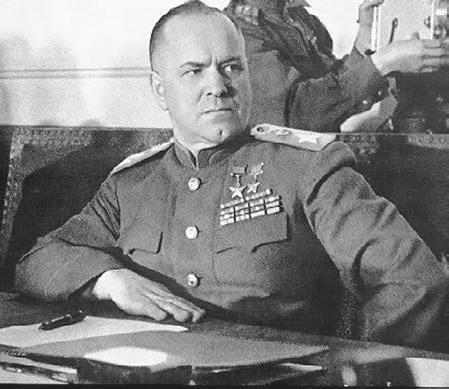
Marshal of the Soviet Union Georgy Zhukov, in 1944 commanded the First Ukrainian and First Belarussian Fronts, and coordinated actions of Soviet troops on the territory of Ukraine and Belarus
Furthermore, to quote Riasnoj as presented by Chuev:
“Yes, evict Ukraine – this is not Chechnya or the Crimean Tatars. I identified the most active enemies of the Russian people and the Soviet government – hardened wolves. My boys filled several trains and sent them. But then they suddenly stopped this order. In this, which I didn’t know at first, the Commissar for Ukraine did not know about. Something happened between the Ukrainian chiefs and our real leaders, having a difference on whether to engage in this matter. They say, the Ukrainian leaders threw themselves to the feet of Stalin begging him to stop the evictions. And Stalin gave in.”
No other documents record the Soviet leadership’s intent to evict Ukrainians. However, the facts and documents confirm that hundreds of thousands of Ukrainians were blamed, for example, in the involvement of the liberation movement in 1944 and after, until the death of Stalin, and they were deported to camps and exile.
There is an undeniable fact that reprisals against Ukrainians who lived under German occupation continued to be committed a long time after the war. This was not only in the form of deportation or detention, the punishments often had slightly different, and at first glance a gentler nature. Their right of access to higher education and certain positions was limited. But this meant millions of lost out on their dreams, careers, and above all – life. For a long time, the Communist regime treated those who survived the occupation as second class citizens.







