Myth 44 – The Flag Raised Over the Reichstag Was Done by Yegorov and Kantaria

Myth
44

The Flag Raised Over the Reichstag Was Done by Yegorov and Kantaria

Yana Prymachenko

History of the Great Patriotic War of the Soviet Union

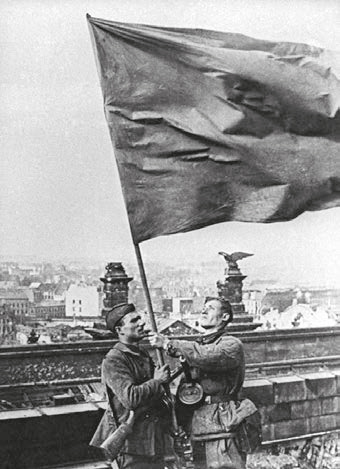
“Early in the morning of 1 May 1945 on the statuary terrace that crowned the building, the Victory Flag was already waving. It was raised by the intelligence sergeants M. A. Yegorov and M. Kantaria.”

■ The Essence of the Myth

Another Soviet taboo about the war, one name is no longer on that list of flag bearers, Ukrainian Oleksij Berest was struck off the list.

■ Fast Facts

On the night of 1 May 1945, Lieutenant Oleksij Berest together with Mikhail Yegorov and Meliton Kantaria raised the Victory Flag over the Reichstag. All three were presented with the title Hero of the Soviet Union. But Oleksij Berest was not included on the award list. According to one version, Marshal Georgy Zhukov personally did this since he did not like political officers. Another explanation is that a Ukrainian figure among the bearers was undesirable for political reasons because the Ukrainian liberation movement stubbornly resisted Soviet rule in Galicia and Volhynia. Some argue that the reason for the removal of Berest off this list was personally done by Stalin.

■ Detailed Facts

From the very beginning, the history of the raising of the “Victory Flag” over the Reichstag had more questions than answers. In 1960–1961, the Marx-Lenin Institute under the Central Committee of the Communist Party of the Soviet Union created a special commission which had to dot all the “i’s.”

The results of this commission slightly changed the official version. However, this had no effect on the fate of the officers and soldiers involved. The Soviet leadership did not want radical revisions, limiting it to a “facelift.” Yegorov and Kantaria remained as the official “bearers”.

On the eve of the storming of the Reichstag, the Military Council of the 3rd Shock Army 1st Belorussian Front produced nine Victory Flags – for each division involved. For convenience, the flags were numbered.

The first assault attempt began in the morning of 30 April. They wanted to make a gift to Stalin for 1 May and anything short of victory would be a cruel joke. Not checking information carefully, High Command reported that at 14:25 the fifth “Victory Flag” was raised on the Reichstag. This fifth flag belonged to the 150th Rifle, Order of Kutuzov 2nd class, Idritsa division.

Word immediately reached Moscow and it then instantly spread around the world. Thus, when it became clear that this was not the case, it was too uncomfortable to refute the information. In addition, the commander of the 79th Corps, General-Major Semen Perevortkin, who was in charge and whose soldiers stormed the Reichstag, was afraid to anger Marshal Zhukov. To somewhat remedy the situation, the commander of the 150th Division, General-Major Vasyl Shatilov instructed the commander of the 756th Regiment, Fyodor Zhinchenko, to urgently raise the flag at least on the first floor of the Reichstag. The first red flag in front of the Reichstag was raised by a Ukrainian, Sergeant Petro Scherbina.

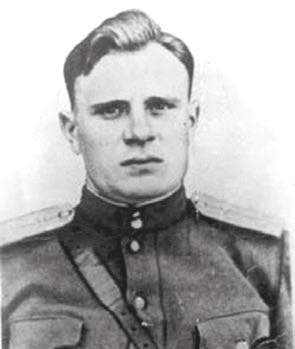
Oleksij Berest

The real storming of the Reichstag began on the evening of 30 April. The first “Victory Flag” in the opinion of most researchers, was raised at approximately 23:00 by Captain Vladimir Makov. However, he, like the rest, did not survive. Perhaps, he burned in the fire or fell from the Reichstag because he was not properly secured.

Yegorov and Kantaria with the Victory Flag on the roof of the Reichstag. Berest is not in the frame

Around midnight, the captain of the 1st Infantry Battalion, Stepan Neustroev, ordered his subordinate, Lieutenant Oleksij Berest, to lead the group that had to set flag #5 on the dome of the Reichstag. Afterwards, the leadership presented awards to the three “bearers” – Berest, Yegorov and Kantaria. All of them were perfect from the point of view of the Soviet leadership, their biographies fitted the image of a Soviet hero.

Why Oleksij Berest, who led the group, did not remain in the official Soviet “canon” and what was to be blamed for this: his nationality or his position? Even today, this is not known for certain.

On 8 May 1946, for raising the Victory Flags over the Reichstag, the title “Hero of the Soviet Union” was awarded to: Captain Vasili Davydov, Sergeant Mikhail Yegorov, Junior Sergeant Meliton Kantaria, Captain Stepan Neustroev, Senior Lieutenant Konstantyn Samsonov.

Oleksij Berest’s postwar fate ended tragically.

After the war, Berest settled in the Rostov province, Russia. He worked as a district commander of the cinema department. Not abandoning his attempts to restore justice, he wrote to various authorities. Perhaps this was the reason for the audit of his department and detection of a lack of funds. In 1953, a criminal case was brought against Berest. He received 10 years in a Perm camp. He sat out half his sentence and was released under an amnesty. After his release, he worked in the Rostselmash foundry. He died on 3 November 1970, rescuing a 5 year old girl from a train.

On 6 May 2005, the President of Ukraine V. Yushchenko posthumously awarded Oleksij Berest the title of Hero of Ukraine.