Myth
46
Victory Day Has Always Been the Most Important Holiday in the USSR
Sergii Riabenko
Russian Television
Channel
Pervyi Kanal,
9 May 2014
“Victory Day – a national holiday, the first and foremost in our country.”
■ The Essence of the Myth
In the Soviet Union, Victory Day has always been the most important holiday.
■ Fast Facts
Victory Day, as a national holiday and non-working day, was introduced in the USSR in May 1945. However, in December 1947, it ceased to be a national holiday. Until 1965, there were no special events conducted on 9 May. During this time, a much bigger Soviet holiday was celebrated on 1 May, International Worker’s Day, and 7 November, the anniversary of the October Revolution. The 9 May holiday only became a national holiday in 1965, when the cult of the “Great Victory” began.
■ Detailed Facts
In today’s Russia, propaganda efforts have made Victory Day into the biggest national holiday. Its scope has long overshadowed New Year’s Eve and other public and religious holidays. Senior Russian leaders do not tire of stressing the “holiness” and almost sacred meaning of Victory Day to all the other former countries of the USSR. Due to this, for people born after the collapse of the USSR, 9 May has always had a special meaning. Many are convinced that in Soviet times, Victory Day was the primary national holiday. Russian propaganda strongly supports and extends these beliefs.
The myth about the “most important holiday” was intended to create a link between contemporary Russia and the Soviet Union, one which was “feared” and “respected” by all Western countries. Due to this propaganda, the period of time has come to be perceived as a kind of golden age and the current Russian leadership appear to be the successors of this “glorious” Soviet tradition.
But time to get back to the facts.
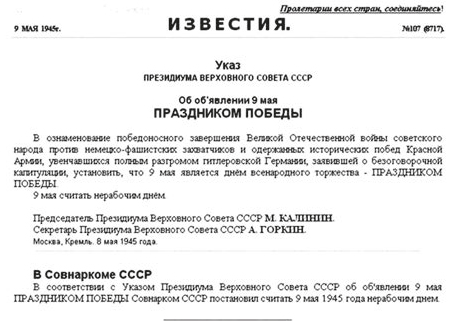
Victory Day first emerged in the Soviet Union on 8 May 1945. Then, the Presidium of the Supreme Soviet of the USSR issued a special decree declaring 9 May, Victory Day, a national day of celebration and decided to make it a non-working day. However, no special celebrations were organized. Even the Victory Parade ordered by Stalin in Moscow was held on 24 June.
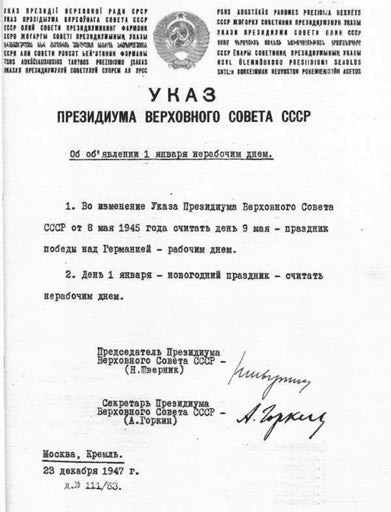
There were no special celebrations, festive parades or processions of veterans on Red Square in the following years. In December 1947, the Presidium of the Supreme Soviet of the USSR announced that it would once again become a working day. Instead, the extra holiday day was transferred to 1 January. After this, celebrating Victory Day at the state level was carried out by modest Soviet means. In fact, the only celebrations were artillery salutes which took place in several major cities of the USSR. Exceptions were not even made for the 5th, 10th and 15th anniversary of the Victory.
In contrast, the celebration of 7 November as the anniversary of the October Revolution in the USSR was more ostentatious. The military parade, the demonstrating workers on Red Square and the obligatory presence of the leaders on the rostrum of the Mausoleum. Similar events took place on International Workers Day on 1 May.
Only in 1965 did Victory Day once again become a national holiday. During this occasion, a military parade was held on Red Square. The Victory Flag was first carried out and examples of Soviet intercontinental missiles were displayed to the public. At the same time, a jubilee medal ’20 Years of Victory of the Great Patriotic War 1941–1945′ was awarded the more than 15 million people. Cities of the Soviet Union were awarded the honorary title of Hero City (for more on the Hero City refer to Myth 48). In the Kremlin Palace, congresses were solemnly held with participation of state leaders. The traditional minute of silence honoring the dead was initiated across the USSR on television and radio.
The decision to change the status of Victory Day was taken by the top Soviet leadership, headed by Leonid Brezhnev. During this period, the Communist Party urgently needed to regenerate their authority. So began the active exploitation of the patriotic theme and the creation of the cult of war veterans. In 1967, on the eve of 9 May in Moscow, the Tomb of the Unknown Soldier memorial complex was inaugurated. The Eternal Flame was brought from the grave of the October Heroes in Leningrad. Next to the memorial, the Honour Guard No. 1 was established and the laying of the wreaths by the first people of the state became a traditional event on Victory Day.
As one sees, the value of one of the most important elements of celebrating Victory Day came only in Brezhnev’s era. But then it went on to share this status with 1 May and 7 November.
Decree from the
Presidium of the
Supreme Soviet
of the USSR from
8 May 1945 “On
Announcing 9
May as Victory
Day” (from
the “Izvestia”
newspaper,
9 May 1945)
Among others, there is no other supreme holiday like Victory Day. In many other countries, Victory Day meant celebrating their own victory. More often the war for independence or generally just one of the battles against their invaders.
Victory Day is celebrated for the citizens of Bangladesh (in their war of independence from Pakistan), Vietnam (for the 1965–1975 war against the USA), Estonia (for the battle of Vonnu against the German Landwehr in 1919), North Korea (for the 1950–1953 war against South Korea and the USA), Turkey (for the Battle of Dumlupinar against Greece, which ended the 1922 War of Independence), Croatia (for their war of independence). For these countries, Victory Day is celebrated on other dates which do not coincide with 9 May.
Some countries do not even have a Victory Day in their holiday calendar. This, for example, is Uruguay, New Zealand and Panama.
In Western European countries and in the USA, victory over Nazism is not honored on 9 May but rather on 8 May. This date coincides with the Act of Germany’s surrender coming into force, which was signed by representatives of the USA, USSR and the Third Reich. In most European countries, this day is called Victory in Europe Day, Victory of Nazism Day, Remembrance and Reconciliation Day or just the End of the War in Europe Day. Slovakia celebrates 8 May as the Victory over Fascism Day. In the Netherlands, Liberation Day is celebrated earlier, on 5 May. In Italy, Liberation Day is celebrated on 25 April.
In 2004, the UN General Assembly, in a resolution marking the 60th anniversary of the Second World War, stated that countries can mark their own days of victory, liberation and celebration and declared 8 and 9 May as days of remembrance and reconciliation. The member states of the UN, individuals and non-governmental organizations were invited to celebrate one or both days to commemorate all the victims of the Second World War.
But the world is not limited to the USA, Europe and the former Soviet Union. And beyond their borders, other countries do not celebrate either the day when the war ended in Europe or the day of victory over Nazism. This celebration does not exist in Argentina, Brazil, China, Mexico, Chile, Japan and a number of countries in Africa, Asia and South America.
Only in the former Soviet Union, with the exception of the Baltic States, is Victory Day celebrated on 9 May. As a public holiday it exists in countries such as Azerbaijan, Belarus, Armenia, Georgia, Kazakhstan, Kyrgyzstan, Moldova, Russia, Tajikistan, Turkmenistan and Uzbekistan as well as in a number of self-proclaimed “republics”. And this is only through the strength of habit.
In Ukraine, this tradition is gradually receding into the past. From 2015, 8 May is celebrated as a national Day of Remembrance and Reconciliation and 9 May a Day of Victory over Nazism in the Second World War.
Decree from the Presidium of the Supreme Soviet of the USSR from 23 December 1947 “On Announcing 1 January as a Public Holiday”